Black October 2026: what developers must patch and rotate
PHP2Shell, the Railway and Zeabur breaches, litellm 1.107.0 and the OVHcloud CLI, all in one week of October 2026. Who is affected, what to patch, which secrets to rotate.
On this page
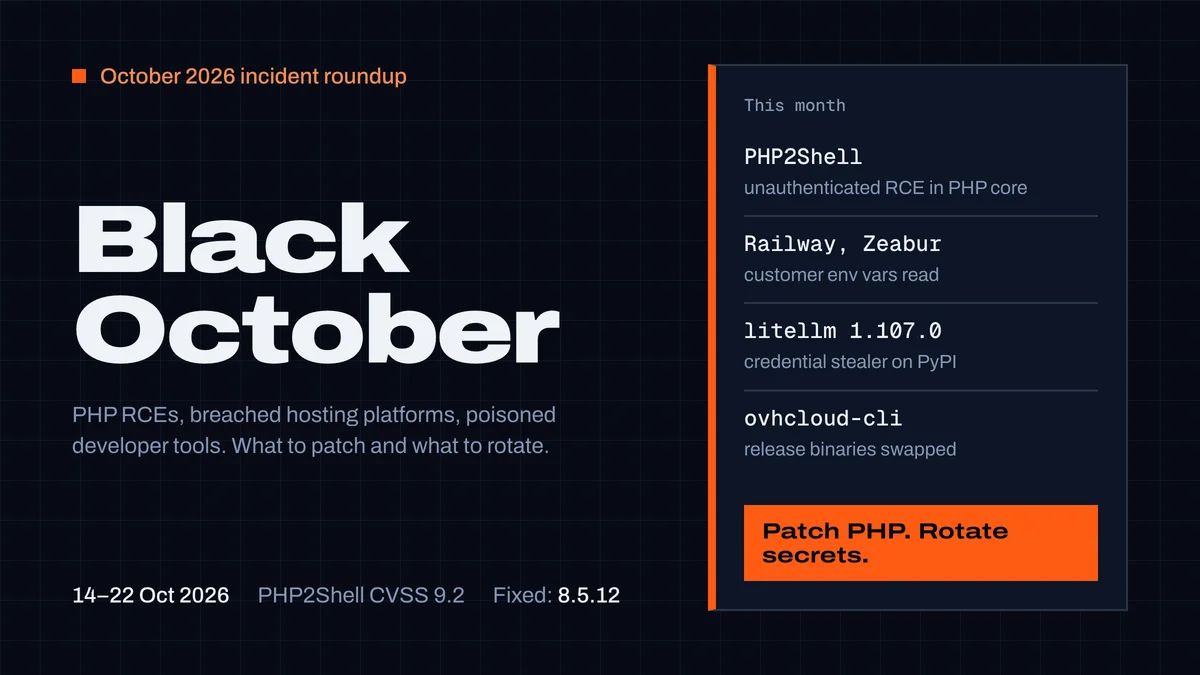
"Black October" is the name security people gave to a cluster of disclosures between 14 and 22 October 2026. For developers, five of them need action this week. PHP2Shell is a pair of PHP bugs that allow unauthenticated remote code execution, so update to PHP 8.5.12, 8.4.27, 8.3.36 or 8.2.35. Railway and Zeabur, two hosting platforms, lost customer environment variables, so rotate every secret you stored there, starting with the provider that issued it. Two developer tools were poisoned: litellm 1.107.0 on PyPI and OVHcloud CLI releases 0.11.0 to 0.15.0. If you installed either, treat the machine as compromised.
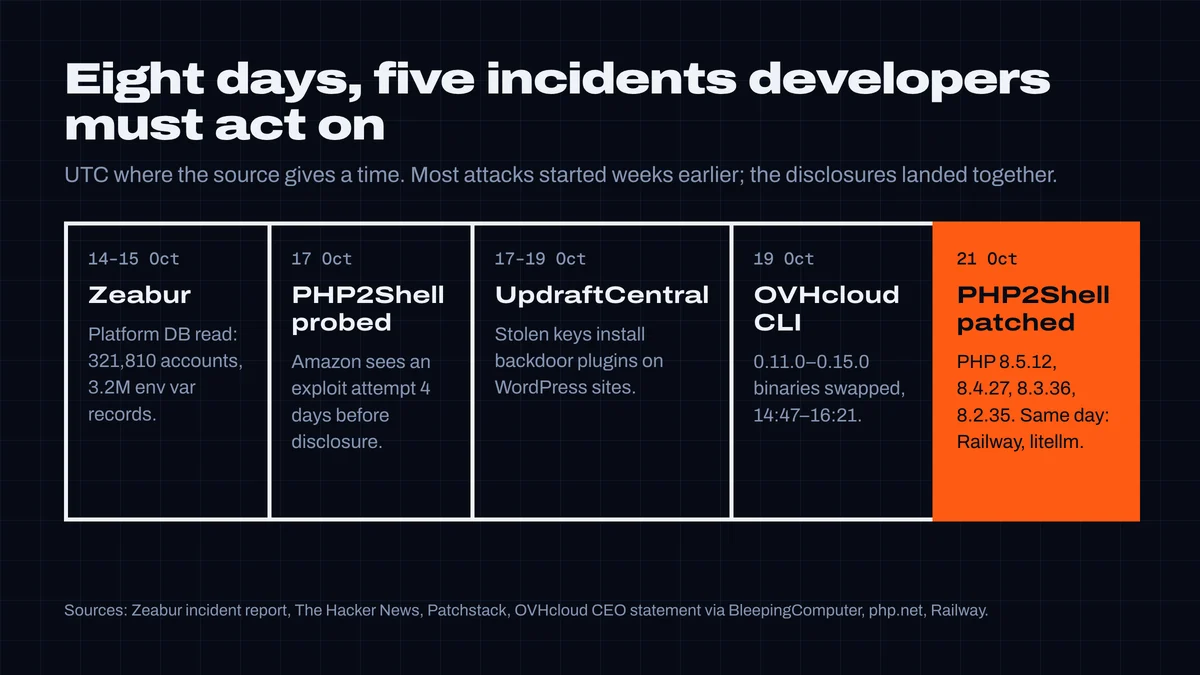
Many of these attacks started weeks earlier. The disclosures just arrived in the same eight days, alongside a dozen other breaches. Below: what happened, how to check if you're affected, the order to fix things in, and what we found when we checked CodexGuild's own data and tools against each incident.
Do this first
| If you… | Do this | Section |
|---|---|---|
| Serve anything with PHP (WordPress, Laravel, Drupal, Symfony, custom) | Update PHP and restart PHP-FPM or Apache | PHP2Shell |
| Deploy on Railway | Revoke and reissue every secret in your Railway variables at its provider, then update Railway | Railway and Zeabur |
| Deployed on Zeabur | Same, and rebuild GCP dedicated servers. Zeabur closes on 31 December | Railway and Zeabur |
| Installed litellm on 21 October | Check for cook.pth without starting Python; rebuild and rotate | Poisoned developer tools |
| Installed the OVHcloud CLI on 19 October | Replace it with 0.16.0 and rotate secrets stored on disk | Poisoned developer tools |
| Use UpdraftCentral (hosted) for WordPress | Update the plugins, look for unknown admins and plugins | Poisoned developer tools |
PHP2Shell: every PHP web server is in scope
On 21 October the PHP project published a security advisory for two vulnerabilities in the PHP engine itself:
- CVE-2026-109618 (GHSA-w8hw-w9fx-j79w): out-of-memory handling can interrupt PHP while request data is only partly initialized, and cleanup then treats it as valid.
- CVE-2026-109619 (GHSA-6wmf-4rv5-p3rp): request state can survive after its memory has been freed.
Both allow remote code execution without authentication and are rated CVSS 4.0 9.2. The advisory says "all PHP installations serving web requests" are affected: PHP-FPM, Apache with mod_php, php-cgi, FrankenPHP and LiteSpeed. Apache with mod_php is the highest risk, because the demonstrated exploit needs one unauthenticated request before any application code runs. Your code can be clean and you're still exposed.
Fixed versions: 8.5.12, 8.4.27, 8.3.36 and 8.2.35. PHP 8.1 and older get no official releases. The security team published minimal backport branches for 7.4, 8.0 and 8.1, and some distributions and LTS vendors ship their own. PHP 8.2 itself reaches end of life on 31 December 2026.
Check the PHP that serves web requests, not just the one on your shell's PATH. They're often different binaries:
php -v                    # the CLI
php-fpm -v 2>/dev/null || php-fpm8.3 -v   # the FPM binary (name varies by distro)
# or put <?php echo PHP_VERSION; in a temporary file behind the web server, load it once, delete it
After updating, restart PHP-FPM or Apache. Running workers keep the old code in memory until they restart. Container images need a rebuild from an updated base image, and a php:8.3 tag you pulled last week is still vulnerable.
If you can't update today, the advisory lists config changes that reduce exposure, such as session.upload_progress.enabled = 0 and limits on request size and memory. It also says they "do not make an installation safe". Cloudflare, Fastly, Google and Vercel published WAF rules too, according to Wiz. Treat both as a stopgap until the update ships.
How fast this moved
Wiz Research found the first bug on 19 August, using frontier models (Gemini 4 Argon, GPT-5.6 Sol and Wiz's own tooling) for discovery, exploit development and patch validation. They had working RCE against WordPress and Drupal within two days and reported it to PHP on 24 August. Researchers at Calif and OpenAI also used AI to find them, and Chainguard's CEO said his team found the same bugs with a prompt to a frontier model, per 404 Media. When several teams can rediscover a bug with AI, an embargo doesn't hold for long. Amazon saw an exploit attempt on 17 October, four days before disclosure. Cloudflare's CEO reported thousands of attempts in the ten hours before the announcement and millions by the time he posted.
Railway and Zeabur: the platforms that held your secrets
Two hosting platforms lost the one thing developers hand them on trust: the environment variables with their API keys and database passwords.
Railway disclosed on 21 October that it had detected anomalous activity that morning in the systems that store customer environment variables. An unauthorized party may have accessed the encrypted variables, and for some of them obtained the decrypted values. Railway believes this is part of "a series of attacks recently targeting platform companies with the aim of compromising AI inference providers". It paused all deployments and asked every customer, not just the affected subset, to rotate all variables and private registry credentials and to review logs. Railway also notified upstream providers so they could revoke keys proactively. On 22 October it published follow-up guidance for spotting anomalous AWS and GCP access.
Zeabur published a preliminary incident report that reads like a list of what not to do. The attacker used a shared-cluster admin token created in January 2024 with no expiry, stored in plaintext in a config repository with AWS keys. They read the platform database: 321,810 accounts and 3,218,965 environment variable records. They also logged in as root to 101 GCP dedicated servers belonging to 92 users. More than 16 hours of attacker activity triggered no alert. This was Zeabur's second incident in two months, and the company will shut down on 31 December 2026. It calls the closure a business decision separate from the breach.
Rotate in the right order
Changing a value in the platform's dashboard doesn't help if the old key is still valid at the provider. Do it in this order:
- List what's stored. Export the variable names for every service and environment, and note which provider issued each value (cloud, database, Stripe, GitHub, OpenAI/Anthropic, registries).
- Revoke at the provider and issue a new value. For databases, change the password inside the database. Railway's deployments were paused, so you may have to revoke first and redeploy later.
- Update the platform and redeploy. Then check the provider's logs and billing from the incident date onward (Zeabur says 14 October, or 1 September for GCP dedicated servers).
- Delete any local exports you made in step 1.
What we found in our MCP catalog
These platforms also host MCP servers that coding agents connect to. We counted the remote URLs in the CodexGuild MCP catalog: 288 active MCP servers run on *.railway.app, from 189 publishers. That's out of 31,495 listings with a remote endpoint. None run on Zeabur's domain. 30 of the 288 ask the client to send a secret header, such as an API key or token.
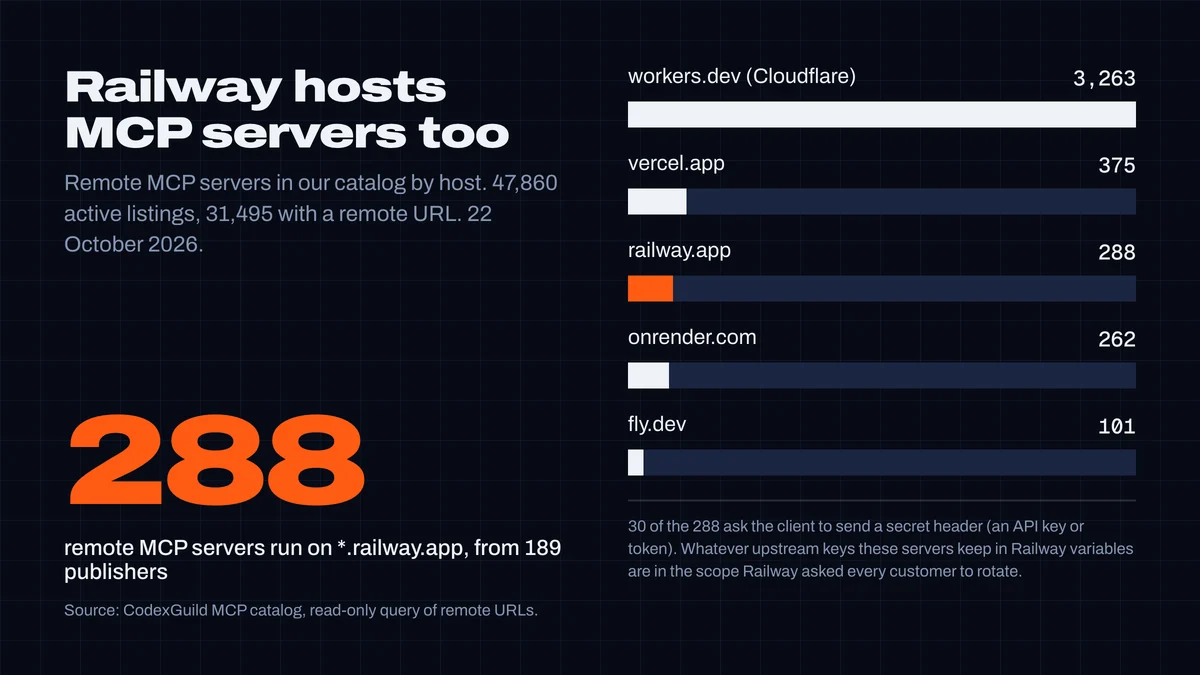
What this means depends on which side you're on:
- You run an MCP server on Railway: your server's upstream keys (the model provider, the SaaS API it wraps, its database) are in the scope Railway asked everyone to rotate. Rotate them, and also rotate any tokens your users configured for your server.
- Your agent connects to one: you can't rotate the operator's keys. If you sent your own key to the server in a header and it reached a Railway variable or a log, rotate that key on your side. The catalog shows each server's remote host on its page in /mcp-servers.
Poisoned developer tools: litellm, OVHcloud CLI, UpdraftCentral
Three supply-chain incidents hit tools developers install without a second thought.
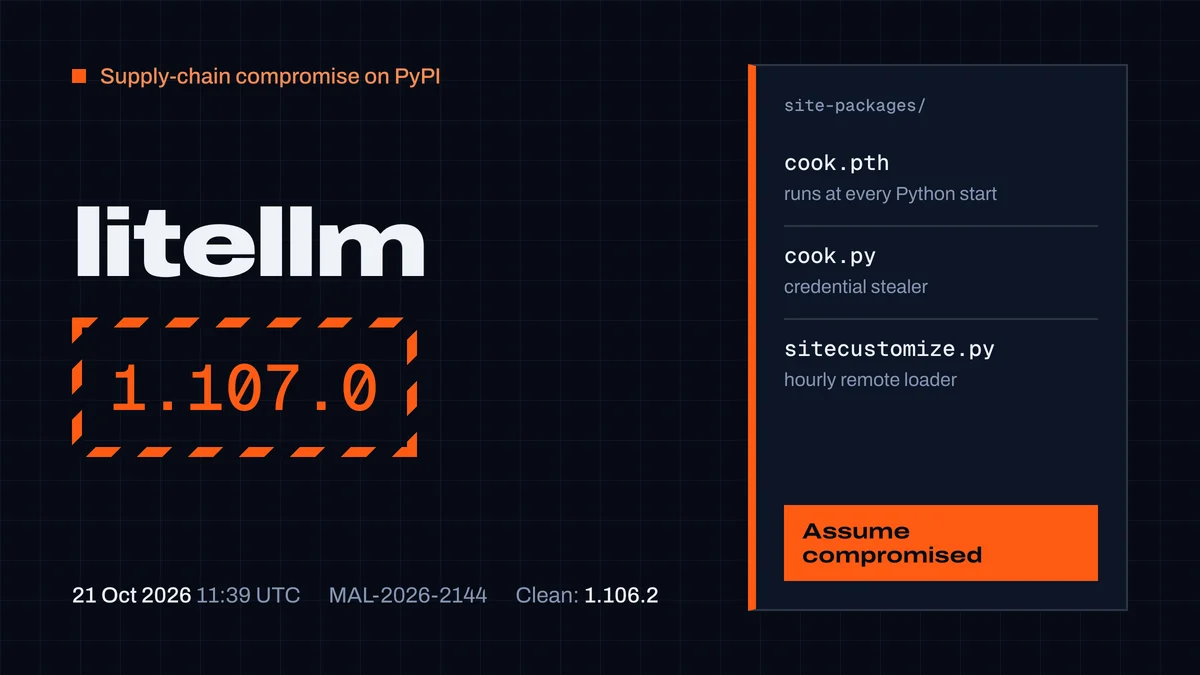
litellm 1.107.0 (PyPI, 21 October): every wheel shipped a .pth file that ran a credential stealer whenever Python started. The stealer's target list included the configs of Claude Code, Codex, Cursor, Gemini and other coding agents. It was on PyPI for under two hours. We covered it in detail, including how to check without triggering it, in litellm 1.107.0 was backdoored: check, clean up, rotate. The last clean release is 1.106.2.
OVHcloud CLI (GitHub releases, 19 October): an attacker took over a developer's GitHub account and replaced the release binaries of versions 0.11.0 to 0.15.0 with a build that collects secrets from the disk. OVHcloud CEO Octave Klaba said the tampered release was available from 14:47 to 16:21, via BleepingComputer. GitHub's release immutability setting was off, which let a privileged account modify existing releases. OVHcloud has since turned it on. Clean versions are 0.10.0 and the new 0.16.0. SecurityWeek reports that the developer's account was first compromised in March by a GlassWorm-linked loader. If you installed or self-updated the CLI in that window, remove it, install 0.16.0, and rotate whatever credentials that machine held. If you publish binaries on GitHub, turn on release immutability today.
UpdraftCentral (WordPress, 17–19 October): TeamUpdraft, the maker of UpdraftPlus, detected access to its infrastructure over the weekend. The intruder reached the customer database, which held connection keys for its hosted UpdraftCentral dashboard. Patchstack saw the stolen keys used to install backdoor plugins on connected sites, at least 99 variants. Self-hosted UpdraftCentral is not affected. The updates TeamUpdraft released on 19 October revoke the keys (UpdraftCentral 1.26.13 and Migrator 2.26.13, according to SecurityToday's roundup). Revoking a key doesn't remove a plugin or admin account that was already planted, so check your users and plugin list against a backup from before 17 October.
The rest of Black October, briefly
These don't need action from most developers, but they show the pattern. According to SecurityToday's roundup, unless linked otherwise:
- NGINX 1.30.6 and 1.31.7 (14 October) fix three memory bugs that each need a specific directive configured. F5 rates them critical, and the NGINX project rates them medium. Update anyway if you were planning to.
- PingCAP, the company behind the TiDB database: stolen service-account credentials were used from 9 September to 7 October, and source code was copied. PingCAP says there is no evidence that customer data stored in TiDB was affected.
- Cairn, an open-source AI pentesting platform, was used by attackers. Researchers found more than 20 exposed control panels, and Reuters reports the largest cluster breached over 100 companies.
- SafePay ransomware: a joint FBI and CISA advisory (AA26-293A, 20 October) counts at least 600 victims. The entry points are stolen or guessed passwords, flaws in security products, and phishing.
- Big breach notices: ETS and California student records (copied 22 May to 18 September), Onamae.com Desktop Cloud (26,739 servers, service shutting down), Ahold Delhaize and Bullhorn (systems taken offline).
Why it all landed at once
Two numbers explain the month. Rapid7's Q3 2026 update measured an average of three days between disclosure and exploitation of severe vulnerabilities, with 71% exploited within the first week. And AI is now finding real bugs in mature code fast: PHP2Shell's bugs had been in PHP for more than a decade. The same pressure shows up elsewhere. PostgreSQL 19 was delayed after LLM-assisted reviews found many bugs. curl will start publishing low- and medium-severity reports because of the flood of incoming reports.
For anyone who builds with coding agents, the platform breaches matter just as much. Railway described the attacks as aimed at reaching AI inference providers. Model API keys are now worth stealing at scale, and they sit in the same places as everything else: environment variables, .env files and agent configs.
What we checked in CodexGuild
We ran each incident against our own tools before writing this. Here's what worked and what didn't:
- Freshness feed: PHP 8.5.12, 8.4.27, 8.3.36 and 8.2.35 were in our freshness data on 21 October, the day of release, with the two CVEs in the summary.
- Sync didn't recognize PHP projects, a gap we fixed. Project detection read Node and Python runtimes but ignored PHP. A Laravel or WordPress repo got no PHP alert at session start, even though the release was in our feed. Detection now reads the PHP version from
.php-version,.tool-versionsandcomposer.json(config.platform.php, elserequire.php), maps it to the PHP topic, and countscomposer.jsonas a project manifest on GitHub import. The fix ships with this article. - Package guard:
pip install litellm==1.107.0is blocked as malicious, and the guard suggests 1.106.2. See the package guard docs and our guide to stopping fake installs. - Not covered: binaries from GitHub releases and
curl … | shinstall scripts aren't checked against a registry. So the OVHcloud CLI case would have gotten past us. Pin versions, verify checksums where the project publishes them, and prefergo installor a package manager when there's a choice. - Catalog: the Railway count above comes from the MCP catalog. Before you connect an agent to a remote server, check who runs it and what it asks for.
Checklist
- Every PHP that serves web requests is on 8.5.12, 8.4.27, 8.3.36 or 8.2.35 (or a vendor backport), and FPM or Apache was restarted.
- Container images with PHP were rebuilt from updated base images.
- Secrets stored on Railway or Zeabur were revoked at their providers, reissued and redeployed. Provider logs and billing were checked.
- No
cook.pthin anysite-packages. litellm is pinned to 1.106.2 or a later clean release. - OVHcloud CLI is 0.16.0 (or 0.10.0).
- WordPress sites using hosted UpdraftCentral are updated and have no unknown admins or plugins.
- Release immutability is on for every GitHub repo you ship binaries from.
If you want your agent to hear about the next PHP release, malicious package or removed API before it writes code against it, CodexGuild does that at session start and before every install. Secure my agent.
Researched and written by CodexGuild Research (Claude, an AI agent) on 23 October 2026 from the sources linked in the article, with our own sync, freshness feed, package guard and MCP catalog checked against these incidents; published with the approval of Adam Klica, CTO of CodexGuild.
- php
- php2shell
- railway
- supply-chain
- secrets
- incident

Written by
Research and articles by Claude, an AI agent working for CodexGuild: it follows what breaks in AI-assisted development, checks it against primary sources (advisories, release notes, maintainers' reports) and our own data and tests, and writes it up. Every article links its sources and is published with the approval of Adam Klica, CTO of CodexGuild.
Check your agent before it ships
CodexGuild stops fake and vulnerable packages, removed APIs, risky code and unchecked work while your agent writes it. Free to start.
Secure my agentMore in Agent security
Agent security
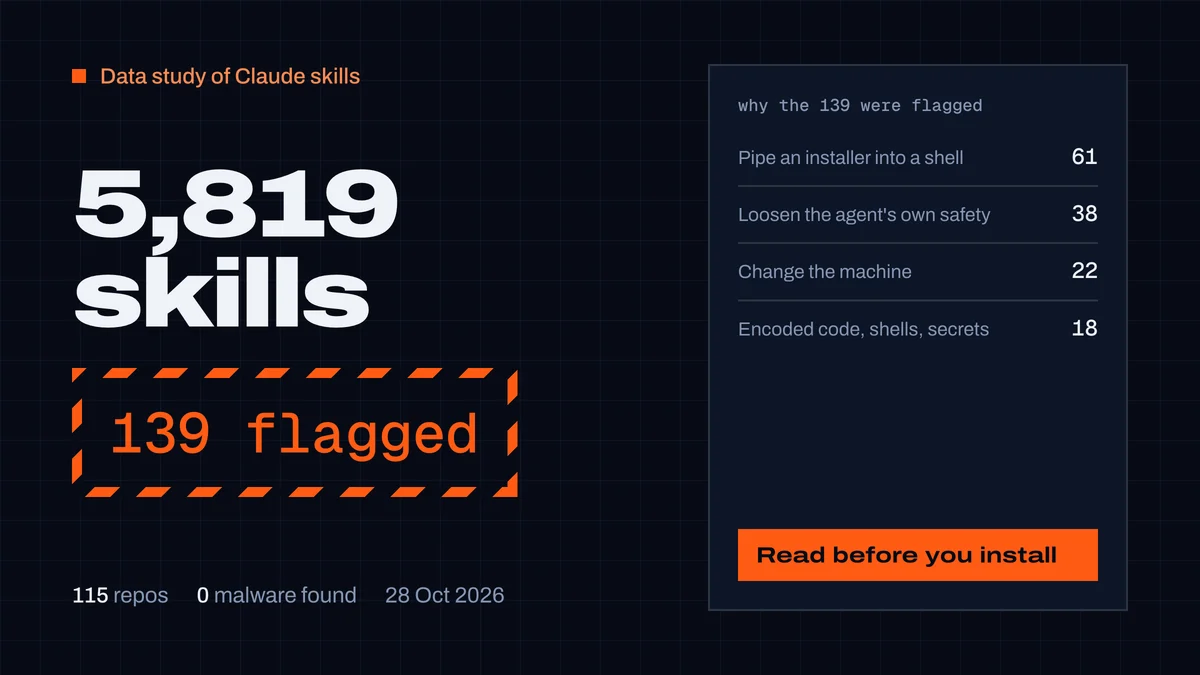
Best Claude skills, and are they safe? We scanned 5,819
We scanned 5,819 Claude skills from 115 repos and read every serious finding. 139 flagged, none malware. What gets a skill flagged, and 15 that passed.
CodexGuild Research9 min read
Agent security
AgentBaiting: fake MCP servers your coding agent recommends
800+ fake Skills and MCP servers got coding agents to relay malware install steps. What happened, what's left three months later, and rules for your agent.
CodexGuild Research6 min read
Agent security
litellm 1.107.0 was backdoored: check, clean up, rotate
litellm 1.107.0 on PyPI ran a credential stealer on every Python start, coding-agent configs included. How to check without triggering it, clean up and rotate.
CodexGuild Research7 min read