- Language
- JavaScript
- Last commit
- 6d ago
- Forks
- 0
- Open issues
- 0
- Registry update
- Oct 15, 2026
Connect
remote$claude mcp add --transport http own-words https://own-words-mcp.alexslkmain.workers.dev/mcpHeaders
Nothing to configure — it works as is.
Security review
Review passedReviewed 3h ago.
- tools
- 1 tools scanned
- metadata
- scanned
No findings.
Tools
1create_deck
Validate a study-deck JSON object and return the shareable own-words link with the card count.
own-words
own-words turns a topic into a deck of question cards. Each card asks a question, you type your answer, and only then does the prepared answer appear; you mark it "I knew it" or "see again" and go on.
I have ADHD. Reading a prepared answer first always felt like understanding, and then the next real question found out that it was not. Typing my own answer first is what stuck, so the deck now makes me do it before it shows me anything.
New here? Try the 2-minute tutorial.
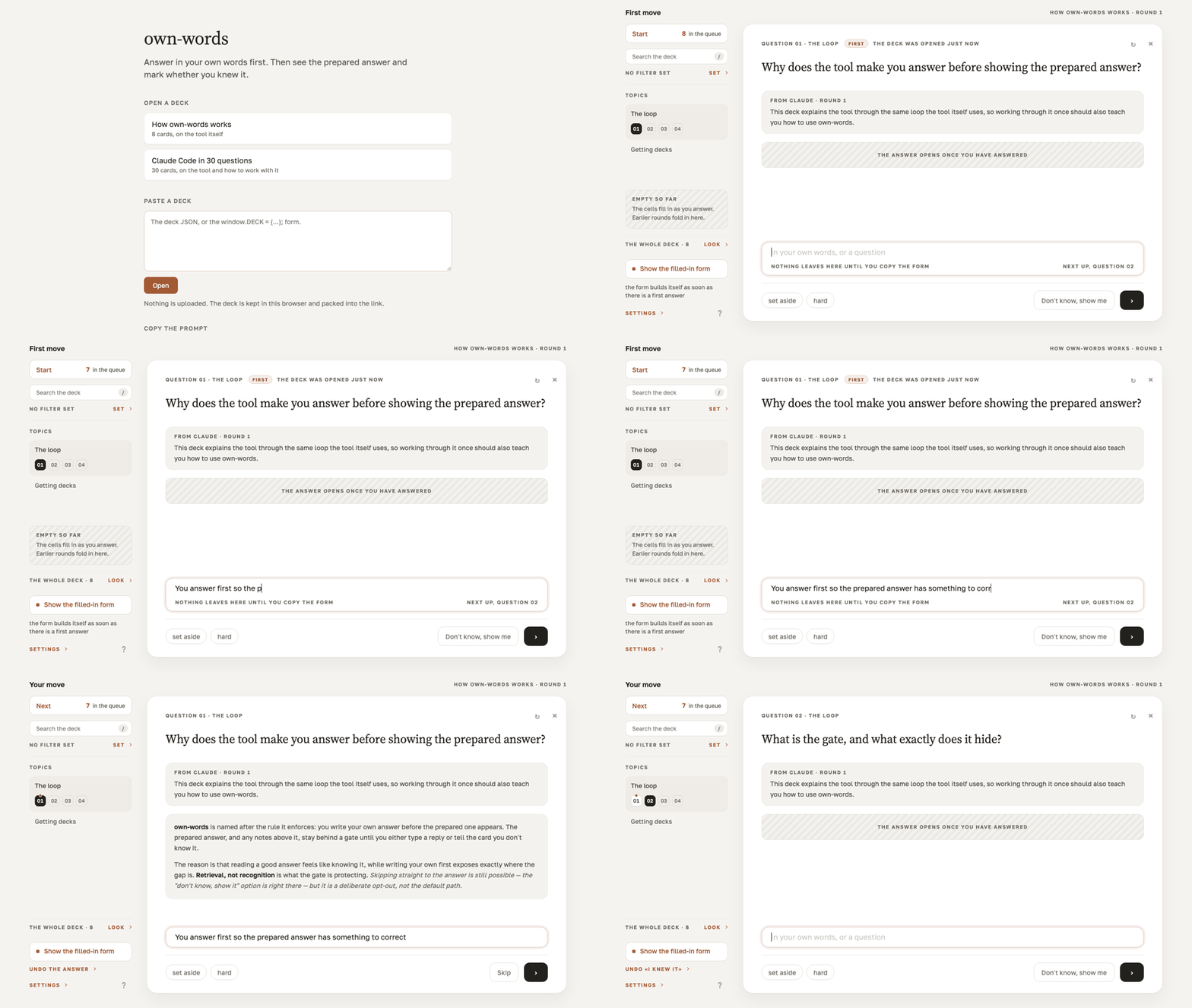
Try it, nothing to install
https://alexslkgit.github.io/own-words/
Two decks are on that page: "How own-words works", 8 cards, and "Claude Code in 30 questions", 30 cards. Open one, answer three or four cards, and you have seen the whole thing.
Make your own deck
No account for any of these.
Paste deck JSON into the box on the landing page. A fenced reply or a line of chat around the JSON is fine; the box finds the deck inside it.
Press "Copy the prompt" on the same page, hand the prompt to any assistant along with your topic, and paste back what it replies with.
Install the Claude Code plugin:
claude plugin marketplace add alexslkgit/own-words
claude plugin install own-words@own-words
Then run /own-words with a topic or a file. It writes <topic-slug>.deck.json in the current
directory, checks it, and prints the link that opens it.
A deck is one JSON file: a key, a title, and blocks of cards, each card a question and an
answer. The two decks above are in decks/ in exactly that form, with nothing in them the
format does not give you. The file is also how a deck moves to another device: the link for the
30-card demo is about 17 KB because the whole deck travels inside it, so keep long decks as
files and share the link for short ones.
A card may also carry a weight, "w": 1 to 100. When any card in a deck has one, three
stops in the header show the whole deck, only cards weighted 60 and up, or only 85 and up, so
a short session covers what matters most. A card with no weight is always shown.
When an answer is too hard to read
Once the answer is shown, tap the words you do not follow, or select a phrase, then press
"Simpler, not longer". The page builds a request whose word budget is the answer's own length;
send it to Claude or any chat and paste the reply back. The page refuses a reply with more words
than the budget, so the card gets clearer without growing. With the plugin, Claude Code also
writes the simpler version into your .deck.json beside the original answer, which it never
changes. For example, with "existential" and "witness table" marked:
Before, 30 words:
somenames one concrete type that the compiler knows but hides, whileanyis an existential box resolved at runtime through a witness table, so its calls cannot be specialized.After, 26 words:
some: one real type the compiler knows, just unnamed.any: a box (fits any matching type) opened at run time, so its calls cannot be specialized.
Where the deck lives
The link carries the whole deck inside the URL, after #d=, compressed with lz-string. A URL
fragment is never sent in the HTTP request, so a deck link opens without any server ever
holding the deck. deck.html renders whatever deck it is handed and knows nothing else.
Every deck you open is kept in this browser's localStorage, under ownwords:decks:<key> and
ownwords:index, together with your answers and marks; the landing lists them under "My
decks". There is no account and nothing you write is stored on a server. Clearing site data
for the page drops the decks and the progress, and "My decks" empties; the .deck.json file or
the link brings a deck back, the progress does not come back.
The one time your text moves is the copy button on a card page. It builds a plain text form of the deck: every card you touched, with the question, your own wording, and your mark, then the numbers of the cards you left alone. Nothing is copied until you press it. Pasting that form back into the chat that wrote the deck is how you ask for harder cards.
Plain HTML and JavaScript, no build step, one vendored dependency (lz-string). The pages ask
Google Fonts for two typefaces; block that and everything still works in a system font,
including from a file:// path.
connector/ is a small remote MCP server so claude.ai can hand you a deck link directly. A
public instance runs at https://own-words-mcp.alexslkmain.workers.dev/mcp: in claude.ai open
Settings > Connectors > Add custom connector, paste that URL and pick No sign-in. It keeps no
state and stores nothing, the deck goes into the link. To run your own, see connector/README.md.
Uninstall
claude plugin uninstall own-words@own-words
claude plugin marketplace remove own-words
The site needs nothing installed, so closing the tab is enough.
Requirements
A modern browser, for the site and for any deck link. The plugin needs Claude Code.
This is one person's tool at version 0.3.0. I use it daily on my own decks; the English strings in it are new, so if a line reads oddly, that is why.
If you tried it on something you actually needed to learn, did writing your own answer first change what you remembered a week later? Open an issue and tell me: https://github.com/alexslkgit/own-words/issues
MIT, see LICENSE.
From the server's repository — third-party content, read it before running anything it suggests.
More in Memory
compound-memory
io.github.chinwe
Local-first shared memory for multiple AI agents that compounds with use; Markdown + git, MCP + CLI.
Semurg agent memory
io.semurg
Self-hosted memory for AI agents over MCP: knowledge graph, vectors, graph RAG, cited answers.
Memento
io.github.jee1
Agent memory MCP server with 4-type cognitive memory, hybrid search, and TTL-based forgetting.
neuromcp
io.github.AdelElo13
Semantic memory for AI agents with hybrid search, knowledge graph, and consolidation
IHMT Memory
io.github.gonzaroman
Long-term memory for AI coding agents, stored as a tree of plain local files.
minutes
io.github.silverstein
The private, owned conversation-memory layer for AI. Record, transcribe, and search every meeting.
Listing from the official MCP Registry · repository facts from GitHub, 3h ago.