- Language
- TypeScript
- Last commit
- 1d ago
- Forks
- 0
- Open issues
- 5
- Registry update
- Oct 16, 2026
Connect
npm$claude mcp add tfl-ts \ -e TFL_APP_KEY=<tfl-app-key> \ -e TFL_MCP_MIN_INTERVAL_MS=<tfl-mcp-min-interval-ms> \ -- npx -y [email protected]
Environment variables
TFL_APP_KEYrequiredsecretTfL API primary key. Live tools need it. Static tools (docs, resolve_line_id, get_supported_modes) do not.
TFL_MCP_MIN_INTERVAL_MSMinimum milliseconds between outbound TfL requests. Default 250. Cache hits do not count.
Security review
Review passedReviewed 1d ago.
- metadata
- scanned
- packages
- 1 checked
No findings.
Tools
This server runs on your machine, so its tool list is not fetched before install — the README below describes what it offers.
TfL API TypeScript Client





Typed TfL client: friendly wrappers, 84 raw REST endpoints, and offline station topology for 20 rail lines.

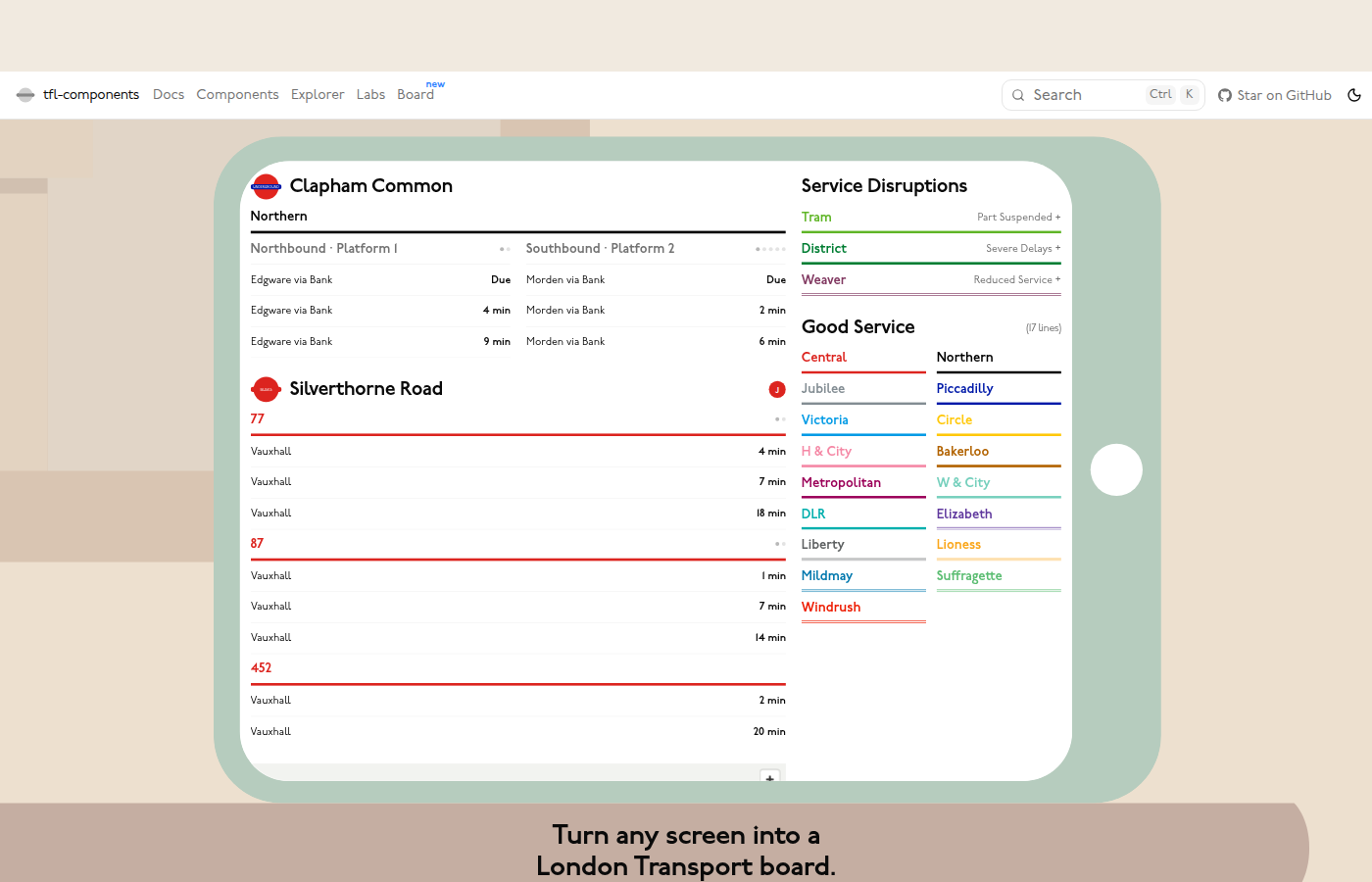
Built with tfl-ts → Board
How this compares
| tfl-ts | tfl-unified-api | tfl-journey-planner | tfl-mcp | mcp-tfl | |
|---|---|---|---|---|---|
| TypeScript types | Yes | No | No | Source only | Yes (src/index.ts) |
| Zero dependencies | Yes | No | No | No | No |
| Raw endpoint coverage | 84 | 10 of 84 | 1 of 84 | 59 of 84 | 8 of 84 |
| Offline station data | Yes | No | No | No | No |
| MCP support | Yes | No | No | Yes | Yes |
Counts use the 84 operations in the committed OpenAPI snapshot (ENDPOINT_COUNT in src/generated/endpoints.ts, pathCount in src/generated/openapi/spec.meta.json). Checked against each repo's source and the package.json published to npm on 16 October 2026.
tfl-ts publishes .d.ts files. Runtime dependencies: none. typescript is a peer dependency, for people compiling against the types. Station order and hubs ship in tfl-ts/meta, with no network call. tfl mcp is the local MCP server.
tfl-unified-api 2.0.2 is JavaScript, with no types field. It depends on moment, request, and request-promise-native. The Line module calls ten of the 84 paths: meta modes, severity, disruption categories, service types, route sequence, route by id, lines by mode, status by id, status over a date range, and status by mode. getRoutesByServiceType builds /Line/Route/{types}, which sits outside those 84 paths. db/lineColors.json is line colours, not stations.
tfl-journey-planner 1.1.2 is LiveScript compiled to JavaScript, with no types field. It depends on request and querystring. The module calls GET /Journey/JourneyResults/{from}/to/{to} only.
@daanrongen/tfl-mcp 1.4.3 is written in TypeScript. The published tarball is dist/main.js, package.json, and README.md, and package.json has no types field. It depends on @modelcontextprotocol/sdk, effect, and zod. Its tools call 59 of the 84 paths. They also call /Road/all/Disruption (the snapshot path is /Road/all/Disruption/{disruptionIds}), /Vehicle/EmissionSurcharge, and /Vehicle/UlezCompliance.
@pipeworx/mcp-tfl 0.1.2 sets "types": "src/index.ts", and that file is in the tarball. It depends on @modelcontextprotocol/sdk and tsx. Six tools call 8 of the 84 paths.
Station order ships with tfl-ts, in tfl-ts/meta.
Install and first call
Get a Primary key from the TfL API Portal. Subscribe to "500 Requests per min", then Profile → Show.
pnpm add tfl-ts
export TFL_APP_KEY=your-primary-key
pnpm exec tfl raw line.statusByIds --ids victoria
[
  {
    "id": "victoria",
    "name": "Victoria",
    "lineStatuses": [{ "statusSeverityDescription": "Good Service" }]
  }
]
Line names, station order, and colours ship in the package. Status, arrivals, and journeys hit TfL at runtime.
On the portal you'll see two keys (Primary and Secondary); either works. app_id has been unused since Jan 2021.
Pass credentials in the constructor instead
const client = new TflClient({
  appKey: 'your-primary-key',
});
Quick starts
Node
import TflClient from 'tfl-ts';

const client = new TflClient(); // reads TFL_APP_KEY from process.env

const status = await client.line.getStatus({ modes: ['tube'] });

const arrivals = await client.stopPoint.getArrivals({
  stopPointIds: ['940GZZLUOXC'], // Oxford Circus
});

const journey = await client.journey.plan({
  from: '940GZZLUOXC',
  to: '940GZZLUBND',
});

const { matches } = await client.stopPoint.search({
  query: 'Oxford Circus',
  modes: ['tube'],
});

const busStops = await client.stopPoint.searchBusStops('Trafalgar Sq');
Next.js
Server Component with ISR (~60s). Boards and explorer: tfl-components · tfl.manglekuo.com/docs/explorer. Tube boards use official line colours; bus boards use route-number chips. Do not mix. See examples/README.md.
import TflClient, { sortLinesBySeverityAndOrder } from 'tfl-ts';

export const revalidate = 60;

const client = new TflClient();
const tube = await client.line.getStatus({ modes: ['tube'] });
const sorted = sortLinesBySeverityAndOrder(tube);
pnpm dlx shadcn@latest add https://tfl.manglekuo.com/r/tube-status-board.json
pnpm dlx shadcn@latest add https://tfl.manglekuo.com/r/tfl-roundel.json
The roundel ships a placeholder unless NEXT_PUBLIC_ALLOW_TFL_ROUNDEL=true (you accept trademark responsibility).
Agent / MCP
Read-only MCP (npx tfl-ts mcp), cached and rate-limited. Static tools never call TfL. The npm bin is tfl (dist/cjs/bin/tfl.js); mcp is the stdio subcommand. Setup: docs/mcp.md.
{
  "mcpServers": {
    "tfl-ts": {
      "command": "npx",
      "args": ["-y", "tfl-ts@latest", "mcp"],
      "env": {
        "TFL_APP_KEY": "your-primary-key"
      }
    }
  }
}
Tools: get_supported_modes, resolve_line_id, docs, resolve_stop_id, get_line_status, get_arrivals, plan_journey.
No repo access, or lost your context? npx tfl-ts docs ls lists every bundled agent doc (this README, CLAUDE.md, docs/agent.md, docs/mcp.md, …). docs cat <id> prints one, and docs find <query> / docs grep <pattern> search across all of them — offline, no API key. The local MCP docs tool reads the same catalogue.
Gotchas
- Line IDs are lowercase slugs:
'central','victoria','elizabeth'. Not display names like'Central'. - Stop IDs look like
'940GZZLUOXC'. Resolve withstopPoint.search()orplace.search(). - Bus stops accept 5-digit NaPTAN-style codes in search (for example
'51800'). - Prefer static constants (
LINE_NAMES,STATION_SEQUENCES, mode lists) before live calls. - Cache status for about 30 to 60s. Do not poll arrivals faster than about 10 to 15s per stop.
accidentStatsandairQualityare deprecated.- National Rail arrivals aren't live through TfL:
STATION_HUBStracks Southeastern, South Western Railway, and similar operators for topology, butgetArrivals()returns an empty array for them, not an error. - Tube boards use official line colours; bus boards use route-number chips. Do not mix patterns.
- Roundel trademark: placeholder unless the consumer opts in.
- A line can carry several
lineStatuses. Do not read[0]. UsegetWorstCurrentStatus(line.lineStatuses)for the operative row. validityPeriods[].isNowfollowsdisruption.category === 'RealTime'. It is not a clock check. Planned engineering can be in force today withisNow: false.validityPeriods[].toDateis the window end, not when trains resume. Weekend engineering often ends at00:29Z(01:29 London, end of the traffic day). Overnight-split slices on one row are one possession; do not treat the first overlappingtoDateas the next train.- Severity 20 is scheduled closure (Waterloo & City weekends, end of traffic day), not an unplanned Closed (1).
sortLinesBySeverityAndOrderranks it after incidents. - Circle / H&C / Met
lineIdflips along shared track. UsewithSharedTrackIdentity. Do not rewrite rawlineId.
Before and after
getDetailedStatus() returns shorter types and renamed fields (severity, from, closureType, originName) instead of TfL's generated shapes:
const lines = await client.line.getDetailedStatus({
  lineIds: ['bakerloo'],
  dateRange: { startDate: '2026-08-08', endDate: '2026-08-10' },
});
const s = lines[0]?.statuses?.[0];
s?.severity;
s?.severityDescription;
s?.validityPeriods?.[0]?.from;
s?.disruption?.closureType;
Use getStatus({ detail: true }) or client.raw.line.* for exact TfL field names.
Station sequences
Tube, Elizabeth line, DLR, Overground, Tram, and river-bus pier topology. No credentials, no network. Identity, order, and branches only (no status or arrivals). River piers are not in STATION_HUBS — poll the NaptanFerryPort id. Live topology: client.line.getRouteSequence(). Also on the client: client.line.STATION_SEQUENCES.
import { LINE_STATION_SEQUENCES } from 'tfl-ts/meta';

const bakerloo = LINE_STATION_SEQUENCES.bakerloo;
const outbound = bakerloo.orderedRoutes.find(
  (route) => route.direction === 'outbound' && route.serviceType === 'Regular',
);
console.log(outbound?.stationIds, bakerloo.branches);
Station hubs and normalised arrivals
STATION_HUBS maps each physical station to its sibling StopPoint ids and the specific id that carries arrivals for each line — Liverpool Street's tube id (940GZZLULVT) and rail id (910GLIVST) both resolve to one HUBLST entry, with Central on the tube id and Elizabeth line on the rail id. No credentials, no network.
import { STATION_HUBS, resolveArrivalsStopId } from 'tfl-ts/meta';

const hub = STATION_HUBS['940GZZLULVT']; // any sibling id works
const elizabethStopId = hub && resolveArrivalsStopId(hub, 'elizabeth'); // '910GLIVST'
resolveArrivalsStopId returns undefined when the hub doesn't carry that line, rather than the interchange id — polling the interchange id itself returns zero arrivals from TfL. Third-party National Rail operators (Southeastern, South Western Railway, c2c, and similar) show up in the hub's topology but never return live predictions: TfL's Arrivals API only covers tube, DLR, tram, Overground, and Elizabeth line.
client.stopPoint.getNormalizedArrivals() is getArrivals() plus a cleaned destination (falls through empty or literal "null" towards to destinationName, common on Elizabeth line, Overground, and some bus termini) and platform (compass bound, cleaned label, isUnknown for TfL's literal "Platform Unknown"):
const arrivals = await client.stopPoint.getNormalizedArrivals({
  stopPointIds: ['940GZZLUOXC'],
});
arrivals[0]?.destination.name;
arrivals[0]?.platform.label;
getArrivals() and client.raw.* are unchanged.
client.stopPoint.get and getByGeoPoint lift Direction additional properties onto the stop: towards, compassPoint, and compassBearingDegrees. smsCode is filled from the first-class field or bag SmsCode. Facility keys stay in additionalProperties as TfL strings. parseAdditionalPropertyValue turns a bag value into null / boolean / number / date / text ("yes", "null", unix ms InstallDate). client.raw.stopPoint.* is unlifted. Do not use Prediction bearing (vehicle heading) as the stop flag; a painted stopLetter of W is Stop W, not west.
const [stop] = await client.stopPoint.get({ stopPointIds: ['490013766E'] });
stop.towards; // 'Aldwych'
stop.compassPoint; // 'E'
stop.compassBearingDegrees; // 90
On Circle / Hammersmith & City / Metropolitan shared track, TfL assigns lineId per station, not per train. The same vehicleId can be circle at Victoria and hammersmith-city at Liverpool Street. withSharedTrackIdentity(stopRows, lineIds, networkArrivals) adds sharedTrackIdentity (canonicalLineId from an exclusive-segment hit, or ambiguous + rawLineIds). It does not rewrite raw lineId. line.getArrivals({ lineIds }) with no stopPointId is the network-wide poll that evidence needs.
Colours, severity, and detailed types
import type {
  DetailedLine,
  DetailedLineStatus,
  DetailedDisruption,
  AffectedRoute,
  AffectedStop,
} from 'tfl-ts';
import {
  getLineColor,
  getLineInlineStyles,
  getLineCssProps,
  getLineDarkReadableStyles,
  sortLinesBySeverityAndOrder,
  getLineStatusSummary,
  getWorstCurrentStatus,
  getStatusKind,
} from 'tfl-ts/ui';

const { hex } = getLineColor('central'); // #E32017
const styles = getLineInlineStyles('central');
const cssProps = getLineCssProps('northern');

const tube = await client.line.getStatus({ modes: ['tube'] });
const sorted = sortLinesBySeverityAndOrder(tube);
const worst = getWorstCurrentStatus(sorted[0]?.lineStatuses);
getStatusKind(worst ?? 10);
Northern defaults to outline dark contrast. Pass { darkContrastMode: 'white' } for white fill/text. See CHANGELOG.md (2.4.0). Raw escape hatch: client.raw.line.statusByIds({ ids: ['central'] }).
Realtime
Poll arrivals with the same app_key as REST. No SignalR. Details: docs/REALTIME.md.
const stop = client.realtime.pollArrivals(
  {
    stopPointIds: ['940GZZLUOXC'],
    sortBy: 'timeToStation',
    intervalMs: 30_000,
  },
  (arrivals, meta) => console.log(`[tick ${meta.tick}]`, arrivals.length),
  (error, meta) => console.error(meta.tick, error),
);
stop();
Module index
| Module | Common work |
|---|---|
client.line | Status, detailed status, disruptions, routes, arrivals by line, static LINE_NAMES / STATION_SEQUENCES |
client.stopPoint | Search, arrivals, normalised arrivals, stop metadata, static STATION_HUBS |
client.journey | Journey planning |
client.mode | Mode lists and mode arrivals |
client.search / place / road / vehicle / occupancy / bikePoint / cabwise / travelTimes | Supporting APIs |
client.raw | All 84 REST endpoints (pnpm exec tfl list prints JSON; --text is the old line form) |
client.realtime | Instant-pull polling over REST arrivals |
Zero runtime dependencies (Node, browser, and edge with fetch).
Deeper docs
| Resource | Purpose |
|---|---|
| CLAUDE.md / AGENTS.md | Agent quick-start: static vs live |
| docs/agent.md | Module reference, caching, Next.js patterns |
| .claude/skills/tfl-ts/SKILL.md | Usage patterns and gotchas |
| docs/mcp.md | Local MCP server (includes offline docs tool) |
| CHANGELOG.md | Release notes |
| docs/MIGRATION-v2.md | v1 → v2 migration |
| examples/ | Library → UI mapping (tube + bus) |
| docs/design/agent-friendly-cli.md | Why tfl docs and MCP docs exist |
| docs/design/evals.md | Why pnpm run eval is a rate, not a Jest gate |
All of the above ship in the npm package and are readable offline via npx tfl-ts docs ls|cat|find|grep or the MCP docs tool — no clone required.
Playground demos under playground/demo/ are for clones, not package consumers.
Architecture
OpenAPI snapshot (committed)
  → types.ts        (swagger-typescript-api, types only)
  → rawClient.ts    (owned generator, uniform object-param API)
  → client.raw.*    (public escape hatch)
  → wrappers        (line, stopPoint, …)
pnpm run build compiles TypeScript to CJS and ESM. No network, no OpenAPI regeneration.
Contributing
git clone https://github.com/ghcpuman902/tfl-ts.git
cd tfl-ts
pnpm install
pnpm run build
pnpm run test
Useful scripts: pnpm run generate, pnpm run check, pnpm run check -- --only=drift, pnpm exec tfl list. See LLM_context.md and .cursor/skills/tfl-ts-maintainer/SKILL.md.
License
MIT. Not affiliated with Transport for London.
| npm | tfl-ts |
| GitHub | ghcpuman902/tfl-ts |
| Issues | Report bugs |
| Live demo | tfl.manglekuo.com |
From the server's repository — third-party content, read it before running anything it suggests.
More in Other
REAPER MCP
com.twelvetake
Lets an AI assistant work in your open REAPER project: mixing, MIDI, routing and rendering.
WIA360: AI session probe and match
com.wiaacademy
Probe an AI session with WIA360 missions and match it to a human WIA360 KYEOL profile.
tafsiri-mcp
io.github.gabrielmahia
Swahili, Kikuyu and Luo civic glossaries and language guides for Kenya. Small reference sets.
historia-mcp
io.github.gabrielmahia
Kenya and East Africa history reference: timeline, leaders, heritage sites, ethnic groups, archives.
church-mcp
io.github.gabrielmahia
Kenya faith-community reference: dioceses, denominations, Muslim community, registration. Sample.
ardhi-mcp
io.github.gabrielmahia
Kenya land guides: title search steps, land rates, subdivision, disputes and rights. Sample data.
Listing from the official MCP Registry · repository facts from GitHub, 1d ago.