- Language
- TypeScript
- Last commit
- 2h ago
- Forks
- 0
- Open issues
- 0
- Registry update
- Oct 17, 2026
Connect
npm$claude mcp add repo-pulse \ -e REPO_PULSE_REPOS=<repo-pulse-repos> \ -- npx -y [email protected]
Environment variables
REPO_PULSE_REPOSrequiredAbsolute paths of the git repositories to serve, separated by ':' (';' on Windows)
Security review
Review passedReviewed 1h ago.
- metadata
- scanned
- packages
- 1 checked
No findings.
Tools
This server runs on your machine, so its tool list is not fetched before install — the README below describes what it offers.
repo-pulse-mcp


A read-only Model Context Protocol server that gives an AI assistant insight into local git repositories, so it can answer questions like:
- "What changed since the last release?"
- "Which files change the most? Where is the churn?"
- "Which branches look stale, and which are already merged?"
- "Draft release notes for v0.3.0."
- "Write this week's engineering update."
It runs locally over stdio, needs nothing but Node.js and git, and never modifies a repository.
It is platform-agnostic: it works with any local git repository, whether it was cloned from GitHub, GitLab, Bitbucket or anywhere else, or has no remote at all. It only reads local git history and never contacts a hosting service, so platform data such as pull requests, issues or CI status is out of scope.
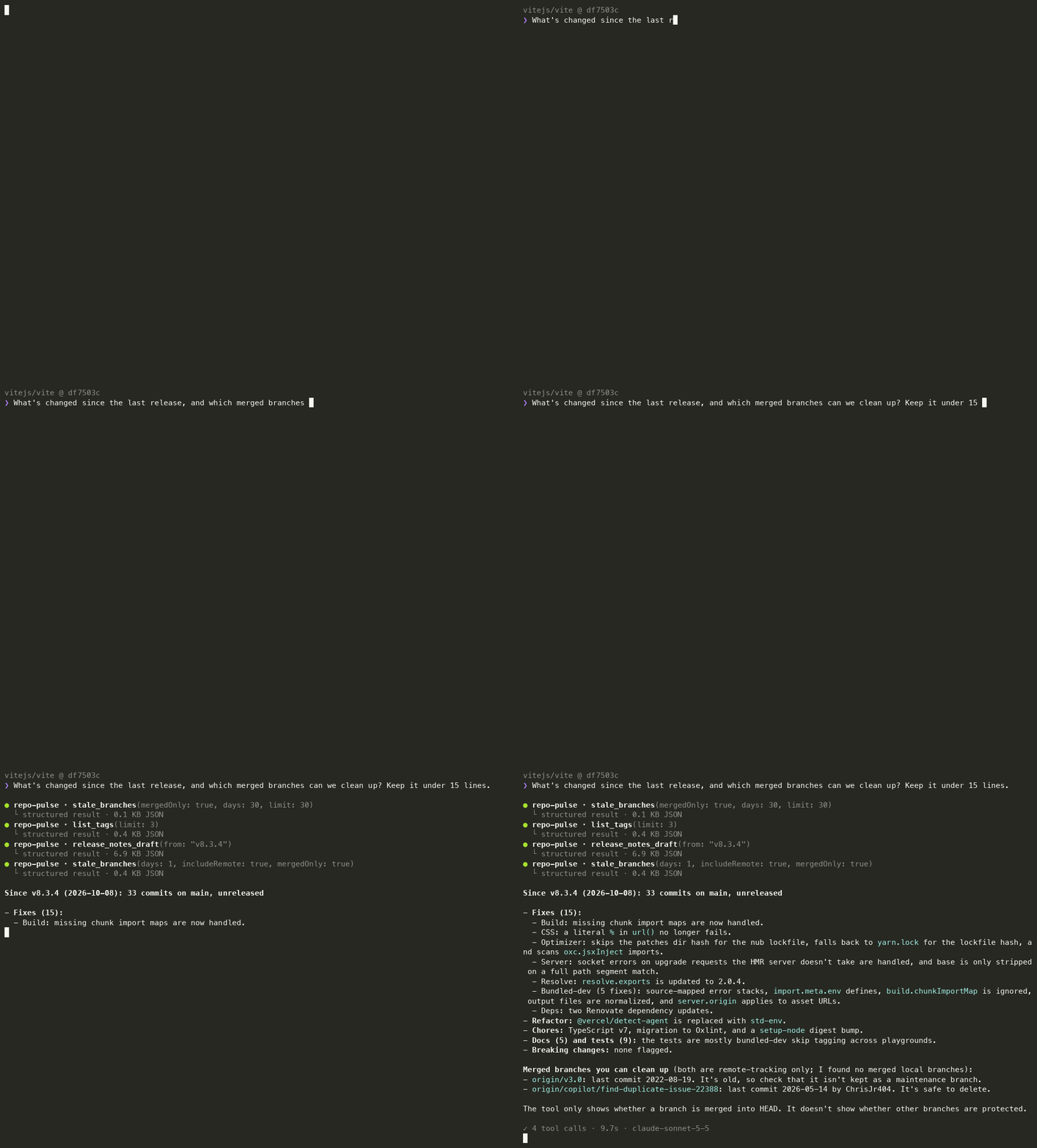
A real Claude Code session on vitejs/vite. See how it was recorded.
Why repo-pulse?
There are already MCP servers for GitHub, GitLab and git itself, and coding agents with a shell
can run git log directly. repo-pulse does not try to replace them. It does a different job: it
turns local git history into answers and is safe to auto-approve.
| repo-pulse | GitHub / GitLab MCP | Generic git MCP / shell | |
|---|---|---|---|
| Returns | Aggregated insights | Platform API objects | Raw git output |
| Can modify anything | No, enforced by an allowlist | Usually yes (token scopes) | Yes |
| Needs a token or network | No | Yes | No |
| Sees local and unpushed branches | Yes | No | Yes |
| Works without a hosting platform | Yes | No | Yes |
| Sees pull requests, issues, CI | No | Yes | No |
What that means in practice:
- Fewer steps, correct numbers. Questions like "where is the churn?", "what goes into the release notes?" or "which branches are merged and stale?" otherwise take several shell commands and hand-written counting pipelines, which can be silently wrong. repo-pulse does the counting in tested code and returns deterministic JSON that says which filters it applied.
- Read-only you can verify. Every tool is annotated
readOnlyHintand backed by a git subcommand allowlist (see Security model), so a client can run it without asking for approval each time. You would not give the same permission to a shell or to a git server that can commit and push. - Useful where there is no shell. Chat clients such as Claude Desktop cannot run
git. With repo-pulse, an engineering manager or tech lead can ask about a repository directly. - Works with anything git can open. It works offline and in air-gapped environments, on self-hosted or remote-less repositories, and it never returns author email addresses.
Use it alongside a platform server, not instead of one. Pair it with the GitHub or GitLab MCP
when you also need pull requests, issues or CI status. If you work in a coding agent that already
has a shell and you only need the occasional git log, you probably do not need repo-pulse.
Benchmark
Claude Code (Sonnet 5.5) answered the same four questions about vite and express twice: once with only a read-only shell and once with only repo-pulse. Full method, answers and caveats are in bench/README.md.
| Question | Shell: turns · time · result | repo-pulse: turns · time · result |
|---|---|---|
| Top 10 hotspots, last 90 days | 2 · 6.6 s · ✅ | 2 · 6.5 s · ✅ |
Files coupled to config.ts | 2 · 7.4 s · ❌ undercounted | 2 · 8.6 s · ✅ |
| Release notes, latest vs previous | 3 · 14.0 s · ✅ | 3 · 12.5 s · ✅ |
| Merged branches stale for 90 days | 5 · 15.9 s · ✅ | 2 · 4.3 s · ✅ |
The honest summary: repo-pulse is not cheaper in tokens for simple one-off questions, because a good model writes compact shell pipelines and repo-pulse's tool definitions cost about 2.5k tokens. It wins on multi-step questions, on getting the numbers right, and in clients that have no shell at all.
Features
| Kind | Name | What it does |
|---|---|---|
| Tool | recent_activity | Commits from the last N days, filterable by author and path |
| Tool | commit_search | Search commit messages for text, optionally by window, author and path |
| Tool | file_history | One file's commits with line stats, following it across renames |
| Tool | file_hotspots | Files ranked by how often they changed in a time window |
| Tool | change_coupling | File pairs that keep changing in the same commits (hidden dependencies) |
| Tool | list_tags | Tags newest first, latest release on HEAD and unreleased commit count |
| Tool | release_notes_draft | Commits between two refs grouped by conventional-commit type + Markdown |
| Tool | compare_refs | Ahead/behind counts and commits between two branches, tags or commits |
| Tool | stale_branches | Branches with no commits for N days, with "already merged" flag |
| Tool | contributor_summary | Commits per author in a time window |
| Resource | repo://{name}/overview | Current branch, last commit, latest tag, commit/branch/tag counts |
| Prompt | weekly_engineering_update | Guides the model to gather data with the tools and write an update |
All tools are annotated readOnlyHint: true, declare an outputSchema, and return both
structuredContent and a JSON text block for older clients.
Requirements
- Node.js 22.12+
- git 2.24+ (for
--end-of-options)
Installation
The package is published on npm, so there is nothing to clone or build. The server only serves
repositories you explicitly allow. Pass them as CLI arguments or an environment variable
(separated by : on macOS/Linux, ; on Windows):
npx -y repo-pulse-mcp --repo ~/code/my-app --repo ~/code/my-lib
# or
REPO_PULSE_REPOS=~/code/my-app:~/code/my-lib npx -y repo-pulse-mcp
Without any configured repository the server refuses to start. It is also listed in the
MCP Registry as io.github.hasanyelaldi/repo-pulse-mcp.
Claude Code
Run this inside the repository you want to ask about:
claude mcp add repo-pulse -- npx -y repo-pulse-mcp --repo "$PWD"
Claude Desktop
Edit claude_desktop_config.json (macOS: ~/Library/Application Support/Claude/,
Windows: %APPDATA%\Claude\) and restart Claude Desktop. Use absolute paths:
{
  "mcpServers": {
    "repo-pulse": {
      "command": "npx",
      "args": ["-y", "repo-pulse-mcp", "--repo", "/absolute/path/to/your/repository"]
    }
  }
}
From source
git clone https://github.com/hasanyelaldi/repo-pulse-mcp.git
cd repo-pulse-mcp
npm ci
npm run build
node build/index.js --repo /absolute/path/to/your/repository
Podman / Docker
podman build -t repo-pulse-mcp .
podman run -i --rm \
  -v "$PWD:/repos/project:ro" \
  -e REPO_PULSE_REPOS=/repos/project \
  repo-pulse-mcp
The repository is mounted read-only. On SELinux hosts (Fedora, RHEL) add ,Z to the volume
options. Replace podman with docker if you prefer; the image uses no Docker-specific features.
For an MCP client, use podman as the command and the rest as args.
Example conversations
You: What changed since the last release?
Assistant (calls
release_notes_draftwith defaults: latest tag → HEAD): Since v0.2.0 there are 14 commits. One breaking change: the config file moved torepo-pulse.json. New features: an author filter for activity and branch merge detection. Three bug fixes, mostly around empty repositories. Here's a Markdown draft you can paste into the GitHub release: …
You: Where has most of the work happened this quarter? Anything risky?
Assistant (calls
file_hotspotswithdays: 90):src/core/insights.tschanged in 23 commits by 3 people, far more than anything else. That's a good candidate for splitting up or adding tests…
You: Can we clean up some branches?
Assistant (calls
stale_brancheswithdays: 30): 6 branches haven't seen a commit in 30+ days. 4 of them are already merged intomainand are safe to delete: …
You: (selects the
weekly_engineering_updateprompt)Assistant (calls
recent_activity,contributor_summary,file_hotspots,stale_branches): Highlights — …
Tool reference
Every tool accepts an optional repo argument: a repository name (the directory name, shown
in the overview resource) or its absolute path. It defaults to the first configured repository.
recent_activity
| Input | Type | Default | Notes |
|---|---|---|---|
days | integer | 7 | 1–3650 |
author | string | – | Substring of the author name, matched literally |
path | string | – | Repository-relative file or directory |
limit | integer | 50 | 1–200 |
Output: { repo, windowDays, totalCommits, truncated, commits: [{ hash, shortHash, author, date, subject }] }
commit_search
| Input | Type | Default | Notes |
|---|---|---|---|
query | string | – | Required. Literal, case-insensitive; matches subject + body |
days | integer | – | 1–3650. Omit to search the whole history |
author | string | – | Substring of the author name, matched literally |
path | string | – | Repository-relative file or directory |
limit | integer | 20 | 1–100 |
Output: { repo, query, windowDays, totalMatches, truncated, commits: [{ hash, shortHash, author, date, subject }] }
file_history
| Input | Type | Default | Notes |
|---|---|---|---|
path | string | – | Required. Repository-relative file, as at HEAD |
limit | integer | 20 | 1–100 |
Output: { repo, path, commitCount, truncated, renamed, commits: [{ hash, shortHash, author, date, subject, path, additions, deletions }] }
Renames are followed, so older commits report the path the file had at the time and renamed is
true when the listed commits span more than one path. Merge commits are skipped; additions and
deletions are null for binary files.
file_hotspots
| Input | Type | Default | Notes |
|---|---|---|---|
days | integer | 90 | 1–3650 |
path | string | – | Restrict to a subtree |
exclude | string[] | – | Up to 20 globs to skip, e.g. ["*.lock", "dist/"]. No / = any depth, trailing / = directory |
limit | integer | 10 | 1–100 |
Output: { repo, windowDays, commitsScanned, scanTruncated, filesChanged, hotspots: [{ path, changes, additions, deletions, authors, lastChanged }] }
Merge commits are excluded and renames are not followed, so a renamed file starts fresh. Use
file_history to trace a single file across renames.
change_coupling
| Input | Type | Default | Notes |
|---|---|---|---|
days | integer | 90 | 1–3650 |
file | string | – | Only pairs that include this file |
path | string | – | Restrict to a subtree |
exclude | string[] | – | Up to 20 globs to skip, same syntax as file_hotspots |
minShared | integer | 2 | Minimum shared commits for a pair to be listed |
maxFilesPerCommit | integer | 30 | Commits touching more files are skipped |
limit | integer | 10 | 1–100 |
Output: { repo, windowDays, commitsScanned, scanTruncated, commitsSkipped, pairCount, pairs: [{ fileA, fileB, sharedCommits, revisionsA, revisionsB, degree }] }
degree is the number of shared commits as a percentage of the average number of commits that
touched each file: 100 means the two files always change together. A high degree between files
that do not import each other usually points to a hidden dependency (duplicated logic, a config
or fixture that must be kept in sync). Large commits such as bulk renames or formatting runs are
skipped because they would couple every file they touch. Merge commits are excluded and renames
are not followed.
list_tags
| Input | Type | Default | Notes |
|---|---|---|---|
limit | integer | 20 | 1–200 |
Output: { repo, totalTags, latestOnHead, commitsSinceLatest, tags: [{ name, date, shortHash, subject }] }
Tags are sorted by tag date, newest first. latestOnHead is the latest tag reachable from HEAD,
which can differ from the newest tag when maintenance releases are tagged on other branches.
commitsSinceLatest counts the commits after it, i.e. unreleased work.
release_notes_draft
| Input | Type | Default | Notes |
|---|---|---|---|
from | string | latest tag before to | Exclusive. Tag, branch or commit hash |
to | string | HEAD | Inclusive |
Output: { repo, from, to, commitCount, truncated, sections: [{ key, title, entries: [{ shortHash, scope, description, author }] }], markdown }
Sections, in order: Breaking Changes, Features, Bug Fixes, Performance, Refactoring,
Documentation, Tests, Build System, Continuous Integration, Chores, Reverts, Other Changes.
A commit is breaking if its header has ! (feat!: …) or its body has a BREAKING CHANGE:
footer; breaking commits also appear in their type section. Merge commits are skipped.
compare_refs
| Input | Type | Default | Notes |
|---|---|---|---|
base | string | – | Required. Ref to compare against (e.g. main) |
head | string | HEAD | Ref to compare |
limit | integer | 20 | 1–100, applies to each commit list separately |
Output: { repo, base, head, baseCommit, headCommit, ahead, behind, status, truncated, aheadCommits: [{ hash, shortHash, author, date, subject }], behindCommits: [...] }
ahead counts commits reachable from head but not base, behind the reverse. status is
identical, ahead, behind or diverged. Both refs go through the same validation as
release_notes_draft, and the counts include merge commits.
stale_branches
| Input | Type | Default | Notes |
|---|---|---|---|
days | integer | 30 | Minimum age of the latest commit |
includeRemote | boolean | false | Also list remote-tracking branches |
mergedOnly | boolean | false | Only branches already merged into HEAD |
limit | integer | 50 | 1–200 |
Output: { repo, thresholdDays, totalBranches, staleCount, branches: [{ name, lastCommitDate, lastAuthor, daysSinceLastCommit, mergedIntoHead }] }
contributor_summary
| Input | Type | Default | Notes |
|---|---|---|---|
days | integer | 30 | 1–3650 |
includeMerges | boolean | false | Count merges too |
path | string | – | Restrict to a subtree |
limit | integer | 20 | 1–100 |
Output: { repo, windowDays, totalCommits, scanTruncated, contributorCount, contributors: [{ author, commits, firstCommit, lastCommit }] }
Resource: repo://{name}/overview
One resource per configured repository (listed via resources/list, name completion supported):
{
  "name": "my-app",
  "path": "/home/me/code/my-app",
  "currentBranch": "main",
  "detachedHead": false,
  "lastCommit": { "hash": "…", "shortHash": "1a2b3c4", "author": "…", "date": "…", "subject": "…" },
  "latestTag": "v0.2.0",
  "commitCount": 412,
  "branchCount": 7,
  "tagCount": 9
}
Prompt: weekly_engineering_update
Arguments (strings, both optional): repo, days (default 7). Produces a user message that
tells the model which tools to call and how to structure a short stakeholder update.
Security model
The server is designed so that a confused or manipulated model cannot do damage:
- Strictly read-only. git runs through a single function that only allows
log,rev-list,rev-parse,describeandfor-each-ref. Anything else is rejected before a process starts. - No shell, ever. git is started with
child_process.execFileand an argument array, so arguments are never interpreted by a shell. - Repository allowlist. Only repositories passed via
--repo/REPO_PULSE_REPOSare served. Paths are canonicalized withrealpath(symlinks resolved) at startup and compared exactly; unknown repositories get the same error whether or not they exist on disk. If nothing is configured, the server does not start (fail closed). - Input validation. All inputs go through zod schemas with bounds. Refs must look like a
branch, tag, hash or
~N/^Nsuffix: no leading-, no..ranges, no@{}or:syntax, and they are passed after--end-of-options, then resolved withrev-parse --verify. Paths must be relative without..segments and are passed after--with--literal-pathspecs(no globbing). Author filters use--fixed-strings, so they are not regexes. - Bounded work. Result counts are capped per tool, scans stop at 5,000 commits, git output is capped at 16 MB, and every git call times out after 15 s. Truncation is reported in the output.
- Hardened git environment. Inherited
GIT_*variables (e.g.GIT_DIR) are dropped, prompts are disabled, optional locks are off,core.fsmonitoris forced off (a repository's own config could otherwise make git run a program), and external diff/textconv drivers are disabled where diffs are computed. - Less personal data. Only author names are returned, never email addresses.
Out of scope: the server trusts the git binary on PATH and the repositories you allowlist.
It is a local developer tool; it has no network transport and no authentication.
Architecture
src/
├── index.ts              # stdio entry point: config → registry → server → transport
├── server.ts             # MCP layer: tools, resource and prompt with zod schemas
├── config.ts             # --repo / REPO_PULSE_REPOS parsing, repo allowlist (RepoRegistry)
├── errors.ts             # InputError (safe to show) and GitError
├── core/
│   ├── insights.ts       # one method per feature: builds git args, aggregates results
│   └── release-notes.ts  # pure conventional-commit parsing, grouping and Markdown
└── git/
    ├── runner.ts         # the only place that spawns processes (allowlist, limits, env)
    ├── parsers.ts        # pure parsers for git output (no I/O)
    └── validation.ts     # ref / path / author validation
Design notes:
- Process I/O is isolated from parsing.
runner.tsis the only module that spawns processes;parsers.tsandrelease-notes.tsare pure functions tested with string fixtures. - Unambiguous output format. git output uses ASCII unit (
0x1f) and record (0x1e) separators instead of tabs or newlines, which can appear in commit subjects and file names. - Testable composition.
createServer()takes its dependencies (allowlist, git runner, clock) as arguments, so tests connect it to an in-memory transport with a fixed "now". - Errors become tool results. Validation and git failures surface as
isError: truetool results with an actionable message, so the model can correct itself instead of the session failing. - stdout is sacred. It carries JSON-RPC, so logging goes to stderr and ESLint forbids
console.log.
Built on the official MCP TypeScript SDK v2 (@modelcontextprotocol/server).
Development
npm ci
npm run dev -- --repo .     # run from source with tsx
npm test                    # unit + integration tests (vitest)
npm run lint                # ESLint
npm run format              # Prettier
npm run typecheck
npm run build               # compile to build/
npm run check               # everything CI runs
npm run inspect             # build first; opens MCP Inspector against this repository
Releasing. Bump the version in package.json, server.json (both version fields) and
SERVER_VERSION in src/server.ts (a unit test fails if they differ), merge, then push a tag:
git tag v0.2.0 && git push origin v0.2.0. The release workflow runs the full check, publishes
to npm with provenance and registers the new version in the MCP Registry. Both use GitHub OIDC
(npm Trusted Publishing and the registry's github-oidc login), so no publishing token is
stored. If only the registry step fails, run the workflow manually (gh workflow run release.yml): it skips npm and retries the registry.
Tests. Unit tests cover the parsers, validation, config parsing and release-notes grouping. Integration tests create a temporary git repository with a scripted history (fictional authors, fixed dates) and exercise every feature, both directly and end to end through a real MCP client over an in-memory transport, including the security checks.
MCP Inspector. npm run build && npm run inspect opens the Inspector web UI connected to this
repository. For scripted checks, the CLI mode works too:
npx @modelcontextprotocol/inspector --cli node build/index.js -e REPO_PULSE_REPOS="$PWD" \
  --method tools/call --tool-name release_notes_draft
Limitations and ideas
- Activity, hotspot and contributor tools look at commits reachable from
HEAD; work on unmerged branches is not counted. - Renames are not followed in
file_hotspots. - Possible next steps: an HTTP transport for team use, per-directory ownership stats.
License
From the server's repository — third-party content, read it before running anything it suggests.
More in Dev tools
jCodemunch MCP
io.github.jgravelle
Token-efficient code exploration via tree-sitter AST parsing. 70+ languages, 86-99% token savings.
NEAT
io.github.neat-technologies
A live graph of your running system, code fused with OTel runtime, that your agent queries over MCP.
Bestax
io.github.allxsmith
Props, examples, CSS variables and Agent Skills for bestax-bulma React components (Bulma v1)
DebugBundle
com.debugbundle
DebugBundle MCP: runtime error reporting, incident response, health checks, and product analytics.
falsepass
io.github.Super-Eric
Find RL environment graders that pay wrong answers: probes reward code, returns reproducible leads
code-graph
io.github.cyberchronos00
Local dependency graph: callers, entry points and file:line evidence for what a change affects.
Listing from the official MCP Registry · repository facts from GitHub, 1h ago.