- Language
- C++
- Last commit
- 3h ago
- Forks
- 2
- Open issues
- 1
- Registry update
- Oct 14, 2026
Connect
npm$claude mcp add cgraph \ -- npx -y [email protected]
Environment variables
Nothing to configure — it works as is.
Security review
Review passedReviewed 1h ago.
- metadata
- scanned
- packages
- 1 checked
No findings.
Tools
This server runs on your machine, so its tool list is not fetched before install — the README below describes what it offers.
README
Nxtsoft/CGraph/README.md
English · 简体中文





Scan a project · extract structure into a deterministic graph · query it in ~10 ms from a daemon, a thin client, or an MCP server.
Contents
Why CGraph? · Architecture · Repository layout · What it produces · Output formats · Performance · Retrieval benchmark · Languages · Quick start · Install & Setup · Use with coding agents · CLI · daemon · MCP reference · Host integrations & enrichment · Development notes · Contributing · License
Why CGraph?
Reading a large repo to answer "what calls this?" or "what breaks if I change it?" means loading dozens of files — and those answers aren't in any single file. They live in the relationships between files. CGraph precomputes them so you (and your AI agent) navigate by graph, not grep.
| 🔗 Reverse dependencies & blast radius | graph_impact returns every transitive dependent of a symbol in ~10 ms. On a real 10,706-node repo it surfaced 93 dependents of one god-file, instantly — an answer grep can't give you. |
| 🧭 Navigate, don't grep | Centrality-ranked search, node neighborhoods, shortest paths, and token-budgeted source bundles — served warm in ~10 ms instead of many file reads that burn context. |
| 🏛️ Architecture at a glance | Centrality ranking surfaces the load-bearing files; Leiden/Louvain community detection clusters the repo into modules automatically. |
| ⚡ Deterministic & fast | A full 10k-node graph builds in ~2 s; no LLM in the extraction path — same input, same graph, every time. |
| 🤖 Built for coding agents | A standard MCP server drops the graph straight into Claude / Codex, so they reason over structure instead of blindly reading files. |
The pitch in one line: for a codebase too big to hold in your head, CGraph is the index that decides which code to read —
ctags/"find all references", precomputed, centrality-ranked, and exposed over MCP.
Architecture
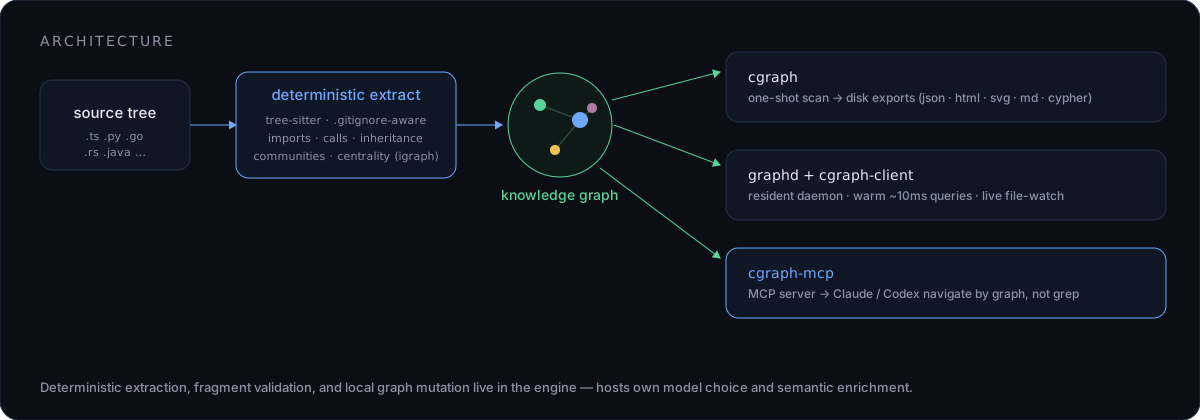
cgraph— one-shot scan → portable disk exports (graph.json,graph.html,graph.svg,obsidian.md,cypher.txt,modules.mmd,modules.svg,design.mmd,design.md).graphd+cgraph-client— a resident per-project daemon with live file-watching; warmquery/path/explain/impact/contextin ~10 ms.cgraph-mcp— a Model Context Protocol server so agents navigate the graph directly.
The engine owns deterministic extraction, fragment validation, cache state, and local graph mutation; hosts own model choice and semantic enrichment.
Repository layout
src/cli/          One-shot CLI entrypoint: cgraph
src/daemon/       Daemon entrypoint: graphd
src/client/       Thin client runtime and cgraph-client executable
src/mcp/          MCP request handling and cgraph-mcp executable
src/engine/       Detection, extraction, graph building, analysis, daemon ops
tests/smoke/      CTest smoke coverage for engine, daemon, MCP, and integration paths
tests/fuzz/       Optional libFuzzer targets
integrations/     Host hook and always-on integration scripts
docs/             Host integration contract and benchmark notes
vendor/           Vendored tree-sitter core and grammars
What it produces
A single scan turns a source tree into an interactive, explorable graph — communities colored, hubs sized by centrality:
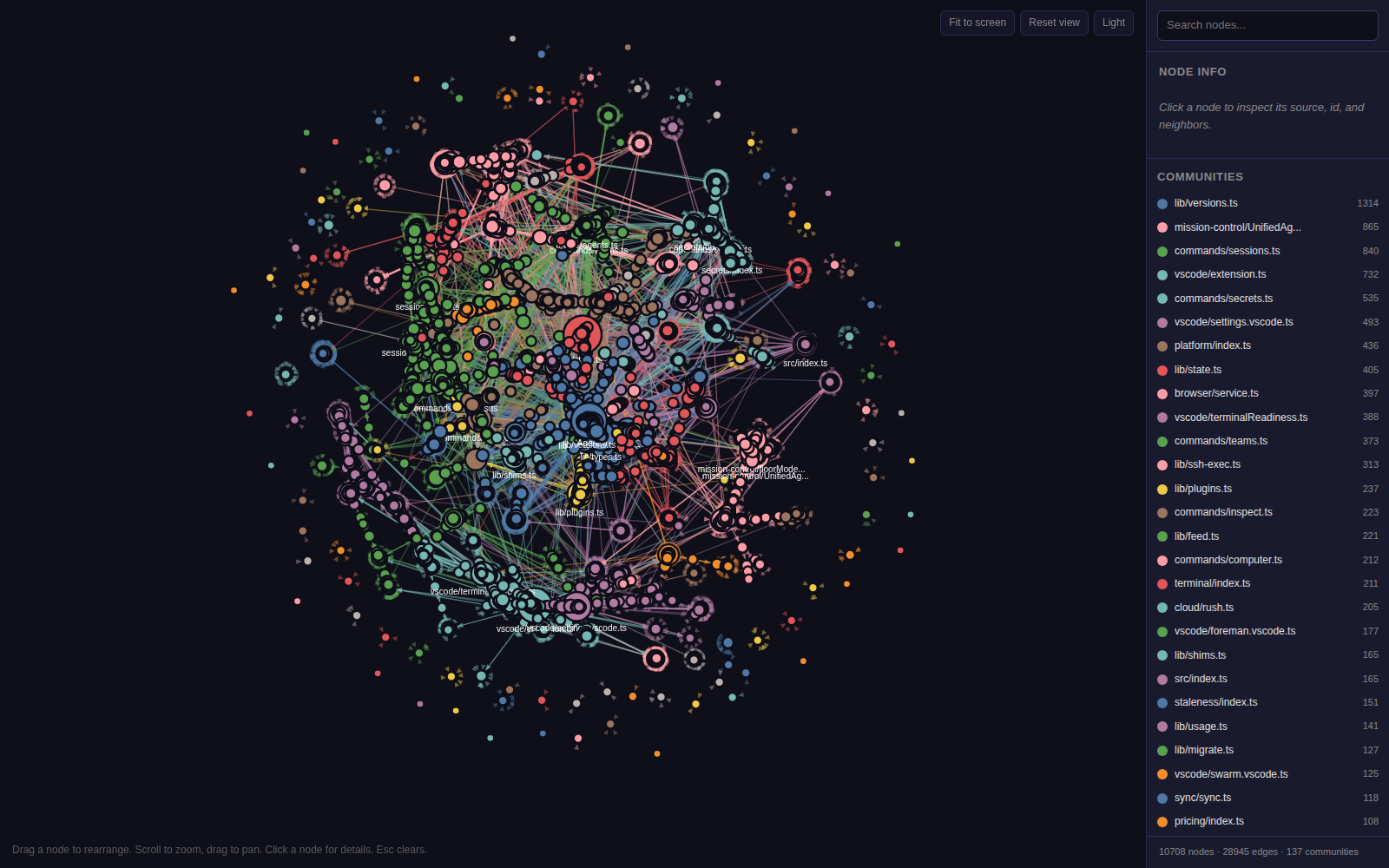
The real graph.html viewer on a 10,708-node / 28,945-edge codebase — self-contained HTML, no external JS.
Output formats
graph.json— directed node-link JSON with graph metadata, nodes, and links. Node ids derive from each file's path relative to the project root, so the same commit built from two checkouts yields the same ids and two graphs can be joined by id;source_filestays the path the graph was read fromgraph.html— browser-readable interactive graph viewgraph.svg— static graph visualizationobsidian.md— markdown export for Obsidian-style navigationcypher.txt— Neo4j Cypher statementsmodules.mmd— module dependency diagram as Mermaidmodules.svg— module dependency diagram as a layered static imagedesign.mmd— entry points and their top call flows as a Mermaidflowchart TDdesign.md— the same as Markdown: entry-point table, nested flows, layers by call distance
Performance
The interactive viewer used to run an O(N²) force simulation in the browser on every open. Layout is now precomputed once in C++ (via igraph), and repaints are viewport-culled — both dependency-free:
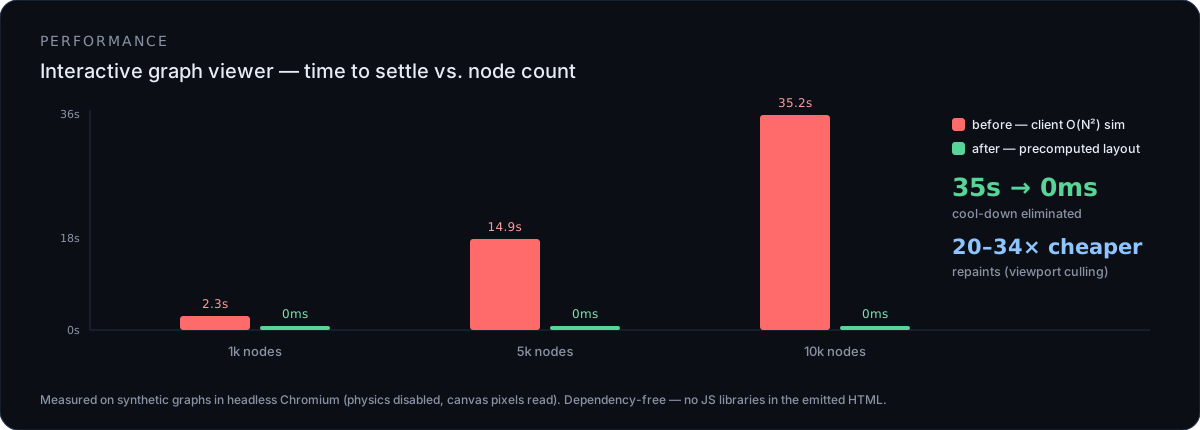
| graph | time-to-settle before | after | per-frame repaint |
|---|---|---|---|
| 10,000 nodes | 35.2 s (main thread pinned) | ~0 ms (static layout) | 20–34× cheaper (zoom/pan) |
Retrieval benchmark
CGraph has been scored on Agent Retrieval Bench: 427 samples from 25 repositories, each checked out at its base commit, scored with the benchmark's own metric code. The table covers all 345 positive samples.
| Method | Recall@20 | MRR | BCY@8k |
|---|---|---|---|
| CGraph bin-v0.9.1 (label + code-text search) | 0.6362 | 0.2787 | 0.4319 |
| CGraph bin-v0.8.3 (label-only text search) | 0.5726 | 0.2356 | 0.3790 |
| RepoMap (published) | 0.6333 | 0.2158 | 0.3788 |
| RepoMap (rerun on this harness) | 0.6311 | 0.2156 | 0.3846 |
| Qwen3-Embedding-8B (published) | 0.7029 | 0.2336 | 0.3732 |
| Qwen3-Embedding-4B (published) | 0.6306 | 0.2379 | 0.3409 |
| BM25 (published) | 0.4452 | 0.1520 | 0.2051 |
How bin-v0.9.1 compares:
- Recall@20. Level with RepoMap (the difference is inside run-to-run noise of about 0.006). Below Qwen3-Embedding-8B. Above the other published single methods.
- MRR. Higher than every published single method.
- BCY@8k. Higher than every published single method, by more than the noise floor.
- Against the paper's fusion of Qwen3-Embedding-8B and RepoMap, on the 287-sample core it reports: MRR is level (the fusion scores only its top 20; CGraph's MRR over its top 20 is 0.276 vs 0.271, inside the noise floor); Recall@20 (0.633 vs 0.733) and BCY@8k (0.440 vs 0.488) are lower.
- Abstention. CGraph does not abstain on no-gold samples.
Per-task tables, pins, the noise floor and caveats are in
bench/arb/RESULTS.md. Reproduce with bench/arb/run.sh.
Languages
Tree-sitter-backed structural extraction, with regex/structured extraction for a few config formats:







Plus structured/regex extraction for Apex, Delphi form/source, MSBuild/XML project files, and MCP config files.
Type members
Seven languages emit a field node per declared member, with a defines edge from the owner:
| Language | Owners with members | Field properties |
|---|---|---|
| C, C++ | class, struct only — not enum or union | none |
| TypeScript, TSX | interface, object type alias, class (constructor parameter properties included), enum | type_text, optional, readonly |
| Go | struct, including multi-name and embedded fields | type_text |
| Rust | named and tuple struct, union, enum variant, trait associated type and constant | type_text |
| Python | class-body assignment, including chained and tuple targets | type_text when annotated |
| Java | class, record, enum | type_text, readonly |
Members are declared members only: no inherited-member expansion, no alias flattening, no runtime
attribute inference. A declaration that is already a node of its own — a TypeScript
method_signature, a Rust trait method or type alias — keeps its function or type node and is not
also a field. A field never takes the id a function or type holds; it moves instead, so a symbol's
id stays stable.
A class-like declaration without a body (struct FileCacheEntry;) is a forward declaration and mints
no node; only the body-bearing definition does.
Fields are members, not navigation targets: graph_context packs the owner (whose snippet spans its
members) rather than the members, and report modules symbol counts exclude them.
HTTP endpoints
JavaScript and TypeScript services get one endpoint node per route the code serves, with the
full path composed across files: an Elysia, Express or Hono chain's own prefix (new Elysia({ prefix: '/notebooks' }), .basePath('/v1')) beneath every .use(child), .use('/p', child) or
.route('/p', child) that mounts it, up to the top-level chain, read through as any and
as unknown as T casts and resolved through imports (aliased ones included). A chain built inline
inside .use(new Elysia({ prefix }).get(…)), a .group('/v2', app => app.get(…)) or .guard()
callback, and a module re-exported as export const deckModule = deckRoutes as unknown as Elysia
all compose the same way. A Next.js app/api/x/[id]/route.ts exporting GET is GET /api/x/:id.
A repository holding a langgraph.json with a non-empty graphs object is a LangGraph Agent
Server: its 49 framework routes (POST /runs/wait, POST /threads/{thread_id}/runs/stream,
GET /assistants/{assistant_id}, ..., the table @langchain/langgraph-api 1.5.1 registers, less its four crons routes, which answer 500 "Not implemented"; see
https://docs.langchain.com/langsmith/server-api-ref) are served endpoints handled by a
langgraph_server node spanning that object, with one langgraph_graph node per graph. A group
the config switches off (http.disable_runs, disable_store, ...) is not served.
Kotlin and Java Spring controllers get the same nodes: a method annotated @GetMapping("/{id}")
(or @PostMapping, @PutMapping, @DeleteMapping, @PatchMapping, or @RequestMapping with a
method) under a class-level @RequestMapping("/api/v1/users") is GET /api/v1/users/{id}.
Paths are read from string literals only (positional, value =, path =, or an array of them); a
path built from a constant, and a method-level @RequestMapping without method, are not minted.
A Spring Boot application whose build.gradle(.kts) or pom.xml applies the Boot plugin (not
apply false; Maven: the Boot parent, or the plugin outside <pluginManagement>, packaging not
pom) and depends on spring-boot-starter-actuator and a web starter serves the Actuator
endpoints its src/main/resources/application[-profile].{yml,yaml,properties} expose: health
by default, else management.endpoints.web.exposure.include less exclude, under
management.endpoints.web.base-path (default /actuator), with the discovery page, health
groups, per-endpoint access, and prometheus / caches only with the Prometheus registry / the
cache module. The liveness and readiness groups are on by default for Boot 4 (unless
probes.enabled is false) and only when it is true for Boot 3 or an unknown version. Where they
sit follows Boot's ManagementPortType: a negative management.server.port or
spring.main.web-application-type: none serves nothing; the same port puts them under the context
path; another port under management.server.base-path. The endpoints are the union over the base
config and each profile, handled by the actuator_exposure node at the include line that won
(or the build file's spring_actuator node when nothing sets it). Endpoints that need another bean
or dependency, profile expressions, placeholders without a default, and YAML anchors, aliases,
tags or flow mappings on the deciding keys are not modeled (those configurations serve nothing);
see spring_actuator.hpp.
Python FastAPI services get them too: a function decorated @router.post("/{project_id}/setup")
(or .get, .put, .patch, .delete, .head, .options, or .api_route(path, methods=[...]),
which defaults to GET) on a module-level router = APIRouter(prefix="/project") or app = FastAPI() is POST /project/{project_id}/setup beneath every include_router(router, prefix="/v1") or app.mount("/v1", sub_app) that mounts it, composed across files through
imports: from api.routes.x import router as x_router (the alias is the only name bound),
from app.routers import users then include_router(users.router) (a submodule), import app.routers.items as items then include_router(items.router), a router a package's
__init__.py imports and another file imports from the package, and each router of a
for r in (users.router, items.router): app.include_router(r) loop over a literal tuple or list.
A path, prefix or methods list that is not a plain string literal (an f-string that
interpolates, prefix=settings.PREFIX), a route or include_router inside a function (an app
factory), and an include_router on anything but a module-level router of its file
(app = create_app(), app.router, self.app, a router imported from another file) are not
minted and are counted in routes_unresolved / mounts_unresolved; a router whose every mount is
one of those mints nothing. A loop over anything else (for r in ROUTERS:) is counted unresolved
without identifying its routers. A router nothing mounts is served at its own prefix, as a
JavaScript router is. add_api_route(...) is not read, and a mount of a longer dotted name
(include_router(api.v1.router)) is counted unresolved without placing its router. Flask is not
read: register_blueprint(url_prefix=) replaces the blueprint's own prefix rather than composing
with it.
The node's id is endpoint:GET /api/v1/notebooks/{}/notes with no repository in it and {} for
every parameter segment (:id, {id}, [id]), its label keeps the provider's spelling
(GET /api/v1/notebooks/:id/notes), and it carries method and path, the handler's file and
span, a contains edge from that file and a handled_by edge to the handler, so graph_impact
on a handler reaches its endpoint. Chains mounted twice serve their routes twice; a route on a
router the file only receives as a function parameter (function register(app) { app.get(…) })
is not minted, and stats.json counts it under route_resolution.routes_unresolved.
Database tables join the same walk. Every CREATE TABLE in a repo's .sql migrations is a
sql_table node, and a Drizzle model declared with a literal name (export const competitors = pgTable('competitors', …), likewise mysqlTable and sqliteTable) gets a maps_table edge to the
table of that name. A dependents walk that reaches a file through an import, or from a
module-level value it declares, also reaches the endpoints the file serves, so graph_impact on
sql_table_competitors goes table, model, the services importing it, their route files, and the
routes. A path through a function, class or endpoint does not serve routes, whether it climbs to
the function's own file or follows an import of the function (and on to the app file that mounts
the route file): a changed function reaches the routes it affects through the calls into their
handlers, not every route nearby. A seam service node is listed when reached but not walked
through, so one consumer edge into it does not pull in every endpoint of that service.
The callers are in the graph too. A fetch(\${API_URL}/api/v1/projects/${id}/publish`, { method:
'POST' }), an openapi-fetch api.GET('/api/v1/projects/{id}', …), an axios.post(…), and a call through a path wrapper (apiFetch(path)whose ownfetch(`${base}${path}`)appends a parameter to a module constant) each give the calling function (or the module-level object the arrow initialises) aCONSUMESedge toendpoint: . The host interpolation is dropped (except a call that takes a runtime value, such as ${base(id)}/x, a URL builder that may hold part of the path, which leaves the request unresolved unless the builder is a function of the same file, which is read), a whole-segment interpolation is {}, the method comes from the call's literal method option, the wrapper's own, or the client verb, else GET. What one file says for certain is read through: a URL held in a local (const url = `${BASE}/x`, new URL(...)thenurl.toString(), a let set per branch), a class field prefix (${this.API_BASE}/v1/...), an axios instance's baseURL (this.api.get('v1/users')underbaseURL: '/api/backend'), a class-method wrapper (this.patch(`v1/users/${id}/enable`)), and a wrapper whose path or method is a later parameter (mlBackendRequest('POST', `/project/${id}/setup`), a method parameter's default applying when a call leaves it out). When this repository does not serve the route the node is minted with served: false and no source; when it does (a Next.js route file fetched from the same app) the one node has both a handler and its callers. A URL whose value the file cannot read, a method a call does not spell out, a relative path (v1/users) with no base ending in /to join it to, or an absolutehttps://literal adds nothing and is counted underroute_resolution.calls_unresolved. Kotlin and Go clients consume the same way: a Ktor client.patch("$baseUrl/api/v1/sessions/$id/invalidate") { … } on a receiver whose name ends like a client (client, httpClient, api; not clientsorhttpCache), Go's http.Get(url)andhttp.NewRequest(method, url, body), and any Go call passing a context, then a method (http.MethodPostor"POST"), then a path, such as c.Do(ctx, http.MethodGet,
"/api/v1/auth/me", nil). A Go route registration (r.Handle(http.MethodGet, "/x", h)), a call with a funcliteral argument,httptestand an assertion onr.Methodcarry no context or a handler, and are no requests. The leading$baseUrl of a Ktor URL is the host; a Go client method's path is relative to its own base, so a value in front of it (n.Base+"/import") leaves the call unresolved. A function whose request appends one of its parameters (postAuth(ctx, path, req)callingc.Do(ctx, http.MethodPost, path, body), or client.post("$baseUrl$path"), also from inside a lambda such as withContext(…) { … }) is a wrapper, and a call to it in the same file with a path literal (c.postAuth(ctx, "/api/v1/auth/login", req), postLoginOutcome(path = "/api/v1/…")) consumes the joined route. A Ktor client.request(url) { method = … }sets its verb in the builder and is counted unresolved. Because the id carries no repository, two graphs built separately share their endpoint nodes.seam fuse scopes every other node id by its service (api::src_db_client_ts`), so two repositories with the same relative file stay two nodes:
cgraph seam discover --graph api=api-out/graph.json --graph web=web-out/graph.json --out seam-drop
cgraph seam fuse --seam seam-drop/chunk_00.json --graph api=api-out/graph.json --graph web=web-out/graph.json --out fused
seam discover writes the seam fragment from what each graph serves (SERVED_BY, HANDLED_BY),
consumes (CONSUMES, CONSUMED_AT) and documents (DOCUMENTED_IN) with no hand-written spec,
and reports how many endpoints matched across services, how many are consumed with no provider
among the graphs, and, when a graph carries a contract document, the drift: endpoints the
document promises that no service serves, and endpoints served that no document mentions.
A front end that reaches its backend through its own catch-all proxy (idp-front-end calls
/api/backend/v1/users/{id}; its app/api/backend/[...path]/route.ts forwards to
${BACKEND_URL}/api/v1/users/{id}) names that with --prefix REPO:/from=/to on both seam discover
and seam fuse (--prefix web:/api/backend=/api). An endpoint web consumes but does not serve,
under /api/backend, then joins the provider's /api/... endpoint; its CONSUMED_AT edge keeps
the consumer's own path as via, and the log counts the endpoints each prefix joined. A route the
front end serves itself (/api/backend/healthz) is never mapped, and a proxied path only the front
end serves is not joined. Each repository's own graph keeps its own spelling. The forwarding target
is not read from the proxy's code: it is built at run time from the handler's parameters, so it is
declared, not guessed.
Contracts other than endpoints are recorded by extractors as provides_contract /
uses_contract facts: header:<name> (case-folded), claim:<name>, env:<NAME>, DynamoDB tables
as dynamo:<name>, gRPC methods as grpc:<Service>/<Method>, message topics and queues as
topic:<broker>:<name>, and tables and graph labels as table:<database>:<name> /
label:<database>:<name>. They do not all join alike:
- Claims and non-standard headers (
x-tenant-id) join like endpoints, by id. A standard HTTP header (authorization,content-type, any IANA permanent field name,x-request-id,x-forwarded-*,traceparent) never joins: every service uses those for its own reasons. Nor does a standard JWT claim, which any issuer writes with the same meaning (iss,sub,exp,email,name,scope,client_id: the IANA JWT Claims registry's RFC 7519, OpenID Connect, RFC 7800, RFC 8693 and RFC 9449 names); application claims (roles,tenant_id,session_id) do. A claim name alone does not say whose token it is in, so the repositories whose tokens one issuer mints can be declared:--issuer idp=idp,web,clispells theirclaim:<name>asclaim:idp:<name>. Between those repositories every claim then joins except the RFC 7519 registered ones (iss,sub,aud,exp,nbf,iat,jti), so OpenID Connect claims (email,name,scope) join there too, and their claims never join a repository outside the issuer. With no issuer declared, claims join as above. A claim is recorded only where the code is provably about a JWT:.claim("roles", r)on a jjwtJwts.builder()or NimbusJWTClaimsSet.Builder()chain, the payload keys ofjsonwebtokensign, joseSignJWTand PyJWTjwt.encode; thejson:"x"tags of a Go struct that embeds golang-jwt'sRegisteredClaims, goes toParseWithClaims, or is unmarshalled from a token's payload segment; the properties of a TypeScript type a decoder returns (jwtDecode<T>, or a function that splits, base64-decodes andJSON.parses segment 1), andv.rolesread off such a decoder's result in any file; KotlinjsonObject["x"]on a hand-decoded payload. A field merely namedrolesorsession_idis not a claim. - Tables and graph labels join only within a declared database. Nothing in code says which
repositories share one, so a table with no known database is
table:local:<name>, local to its repository, until--database turing=turing-api,ml-backendsays both use databaseturing; their tables then meet attable:turing:<name>and no other repository's do. What produces them (src/engine/data_contracts.cpp): a table a.sqlfile creates and a DrizzlepgTable/mysqlTable/sqliteTablemodel of it providetable:; a Drizzle model of a table no.sqlfile in the repository creates is a mirrored schema and uses it, as does every function passing that model todb.update(...),.from(...),.innerJoin(...)and the like. A table named in a Python, TypeScript/JavaScript, Kotlin or Java string uses it only when the string (adjacent literals and+chains joined) opens with an upper-caseSELECT/INSERT/UPDATE/DELETE/WITHand the table follows an upper-caseFROM/JOIN/INSERT INTO/UPDATE ... SET(leading--//* */comments are skipped).users{where_sql},users$filterand"SELECT * FROM users" + wherereadusers; a name ending in_before an interpolation or+, or continued after one (events_{year},events_%s,t{y}_x), is not read. Lower-case SQL, JPQL in a JPA@Query(withoutnativeQuery = true) and test files (tests/,__tests__/,*.test.ts,test_*.py,FooTest.kt, ...) are not read. Spring Data Neo4j@Node("User")provideslabel:Userand an outgoing@Relationship(type = "HAS_ROLE")on itlabel:User.HAS_ROLE; Cypher in.cypherfiles (.cqlis not detected: Cassandra uses it too) and in strings opening withMATCH/OPTIONAL MATCH/MERGE/CREATE (/UNWINDuses the labels, and a relationship only when its start node's label is known. - DynamoDB tables (
src/engine/dynamo_contracts.cpp) join by name with no declaration: a table's name is its whole address in an AWS account, and it is never atable:, so it cannot meet a Postgres table of the same name. In TypeScript/JavaScript files that import the DynamoDB SDK, a write (PutItemCommand,UpdateItemCommand,DeleteItemCommand, lib-dynamodbPutCommand, DocumentClientput/update/delete, ...) providesdynamo:<name>and a read (GetItemCommand,QueryCommand,ScanCommand,get/query/scan) uses it. The name is a literalTableName, the default inprocess.env.X || 'name', or a same-fileconstholding either; the env variables are kept as the node'senv. One variable read with two defaults names two tables (turing-agents-devandwiki-agent-memorystay apart).this.tableName, parameters, env reads with no default, batch requests and test files record nothing. Python (boto3) is not read. Caveat: nothing in code says which AWS account or region a service uses, so adynamo:name joins every repository given to the workspace or seam that names it, whatever account each runs in: two services in different accounts that each have asessionstable would join. An optional account declaration is a recorded follow-up. - gRPC methods and topics (
src/engine/messaging_contracts.cpp) join by name with no declaration. A gRPC method isgrpc:<Service>/<Method>without the proto package (a Gopb.NewCartServiceClientor a PythonCartServiceStubcall never spells it), the method as the proto spells it (Java's and JavaScript'sgetCartand C#'sGetCartAsyncread asGetCart). A server provides it: a method of a class implementing the generated base (Java<S>ImplBase, C#<S>.<S>Base, Python<S>Servicer, C++<S>::Service), a key of a NodeaddService(<S>.service, {...}), or in Go a handler method of the type registered withRegister<S>Server, with the unary shape and its messages from the registration's package. A call on a generated client uses it: GoNew<S>Client, Java<S>Grpc.new*Stubor a<S>BlockingStubfield, Python<S>Stub, C#<S>.<S>Client, TypeScriptnew <S>Clientwith@grpc/grpc-jsimported, each only where the file shows generated gRPC code (a generated-stub import path, a*_pb2_grpcmodule, an<S>Grpcclass named in code, aGrpc.*namespace); through a local, a field orself/thismember bound to one anywhere in the file, and only if the file binds that name to nothing else. gRPC's own services (Health,ServerReflection,Channelz) and OTLP's are never recorded. A topic istopic:<broker>:<name>(kafka,rabbitmq,sqs,sns,pubsub,jms): the producer provides it, the consumer uses it (Kafka in Java/Kotlin/C#/Go/Python/JavaScript, Spring Kafka and Kafka Streams, RabbitMQ on the default exchange, SQS queue URLs, SNS topic ARNs, Pub/Sub topics), and the call's receiver must be that broker's client. The name is a literal, the literal default of an env read, or a name every binding of which in the file is one such literal: a name that is also a parameter, a loop variable, a pattern or bound to another expression reads as nothing. Caveat: two proto packages that each define aCartServicemeet at one id.messaging_contracts.hpplists every pattern read. - Env names join only when declared:
--env ML_BACKEND_URL=ml-backendnames the service the variable addresses (SERVED_BY). An undeclared one (NODE_ENV) stays in its repository.
The --database, --env and --issuer flags go on seam discover and seam fuse, and must be the same on both: a seam joined
under a declaration that fuse is not given is refused rather than silently split.
Contract documents
A contract stated in a document is read as one too. An OpenAPI JSON document (openapi*.json,
swagger*.json; YAML is not read) gives one documented endpoint per path and method and one
schema per component schema with a field per property, linked by RESPONDS_WITH, ACCEPTS,
references and inherits (allOf). A .proto file gives a schema per message and enum, a
type per service and an endpoint POST /<package>.<Service>/<Method> per rpc. A .graphql
schema gives a schema per type, interface, input, enum, union and scalar, and an endpoint
QUERY <field> / MUTATION <field> / SUBSCRIPTION <field> per root operation field. The
openapi-typescript output a TypeScript client is typed against (export interface paths with
operations and components) is read the same way, and its 455-member paths interface no
longer yields 455 field nodes. A documented endpoint has the same canonical id as a served or
consumed one, so it is one node with handled_by, CONSUMES and its document anchor together;
stats.json counts them under route_resolution.endpoints_documented. Schemas are type owners
in report types, so an API schema and its hand-written TypeScript mirror show up as a duplicate
or identical shape. A repository with none of these files gains nothing.
Workspaces
seam discover joins two graphs offline; a workspace joins them live. Put a
cgraph.workspace.json in a directory naming its member repositories and point any of the tools
at that directory instead of a project:
cgraph workspace init --root ~/work --repo api=./turing-api --repo web=./turing-webapp
cgraph workspace status --root ~/work
cgraph-client --root ~/work impact '{"id": "<the handler>", "direction": "dependents"}'
Each repository keeps its own daemon, its own watcher and its own incremental updates; nothing is
copied into a workspace process. A federated impact asks every member about the seed, and where
the traversal reaches an endpoint: node it forwards that contract once to the other repositories
with the depth that remains, so changing an API handler reports the frontend hooks that call it,
each witness tagged with its repo and the contract it came through. path joins two repositories
at a contract the same way, query and explain merge and tag, update fans out, and
workspace init with no --repo discovers every git repository one level down. The manifest's
optional prefixes ([{"repo": "web", "from": "/api/backend", "to": "/api"}]) carry the same
proxy mapping into impact and path, which then cross from web's /api/backend/... placeholder to the
backend's /api/... endpoint and back; a path across it keeps both spellings. A change to web's own
route never reaches web's proxied callers, which hit the backend's copy. Its optional databases
([{"name": "turing", "repos": ["api", "ml"]}]), env ([{"name": "ML_BACKEND_URL", "service": "ml"}])
and issuers ([{"name": "idp", "repos": ["idp", "web"]}]) carry the seam declarations. impact
and path cross at claims and non-standard headers as at endpoints; never at a standard HTTP
header; at an env name only when env declares it; at a member's table:local: id only towards
the other members of its database; and at an issuer member's claim only towards the other members
of its issuer. A repository
whose daemon is down appears in unreachable rather than vanishing from the answer. report,
context and the memory ops are answered per project and say so, naming the roots to use. The
MCP server federates too when its root is a workspace, with no new tool.
A tool opened inside one member repository (or a worktree nested in one) finds the workspace by
looking for cgraph.workspace.json in its parent directories, up to $HOME, and uses it only
when the manifest lists that repository. There, impact and path cross the workspace (the
answer carries workspace: {name, home}) while query, explain, context and status stay in
the home repository, answered from the tree the tool was opened in. cgraph change-context and
the MCP graph_change_context add a cross_service section: for each endpoint the change serves
(the endpoint it edits, one whose handler it reaches, or one in a file it changes) the direct
callers in the other repositories, and for each endpoint it calls (from changed code, or from a
function calling a changed helper) the handler that serves it. The section has its own quarter of
the budget, is never shed to make room for impacts, counts what it trims in
omitted.cross_service, and names every repository that could not answer (unreachable) or was
still building (building), so an empty rows means no caller CGraph can resolve, not that
nobody looked (unless the section is a stub cut for budget, with rows_found saying how many there
were, or carries errors because the workspace manifest could not be used); calls it cannot resolve are counted under route_resolution.calls_unresolved, in stats.json and
in each daemon's status (saved with the graph, so a restarted daemon still reports them).
Changing a route's path or mount counts as removing the old route, so its callers are named.
Quick start
Claude Code plugin
claude plugin marketplace add Nxtsoft/CGraph
claude plugin install cgraph@cgraph
The plugin registers the cgraph MCP server, the cgraph and cgraph-enrich skills and the
pre-edit hook. On first use it downloads the release archive for your platform (Linux x64/arm64,
macOS arm64/x64), checks its SHA-256 against integrations/launcher/release.json and unpacks it into
the plugin's data directory. It needs node and tar on PATH.
Release archive
Download the current Linux x64 release and build your first graph:
mkdir -p "$HOME/.local/lib/cgraph/bin-v0.9.3" "$HOME/.local/bin"
curl -fL https://github.com/Nxtsoft/CGraph/releases/download/bin-v0.9.3/cgraph-linux-x64.tar.gz \
  -o "$HOME/.local/lib/cgraph/bin-v0.9.3/cgraph.tar.gz"
tar -xzf "$HOME/.local/lib/cgraph/bin-v0.9.3/cgraph.tar.gz" \
  -C "$HOME/.local/lib/cgraph/bin-v0.9.3"
for name in cgraph graphd cgraph-client cgraph-mcp; do
  ln -sf "$HOME/.local/lib/cgraph/bin-v0.9.3/$name" "$HOME/.local/bin/$name"
done
export PATH="$HOME/.local/bin:$PATH"

# Run this from any source repository.
cgraph --root . --out cgraph-out
Open cgraph-out/graph.html in a browser (open cgraph-out/graph.html on macOS), then register CGraph with your coding agent. See Install & Setup for other architectures and source builds.
Install & Setup
Release bin-v0.9.3 provides all four executables (cgraph, graphd, cgraph-client, and cgraph-mcp) in each archive:
| Platform | Architecture | Archive |
|---|---|---|
| Linux | x86_64 / amd64 | cgraph-linux-x64.tar.gz |
| Linux | arm64 / aarch64 | cgraph-linux-arm64.tar.gz |
| macOS | Apple silicon / arm64 | cgraph-macos-arm64.tar.gz |
| macOS | Intel / x86_64 | cgraph-macos-x64.tar.gz |
Use uname -s and uname -m to select the archive. The quick start installs versioned files under ~/.local/lib/cgraph/bin-v0.9.3 and puts stable symlinks in ~/.local/bin; add that directory to your PATH if needed. MCP client configs should use the absolute versioned path, because clients may not inherit your shell's PATH.
Build from source
Full build recipe — prerequisites · vcpkg · PATH · sanitizer & fuzzer presets
Prerequisites
- CMake 3.25 or newer
- Ninja
- A C++20 compiler (recent Clang or GCC; Apple Clang from Xcode Command Line Tools works)
- A Fortran compiler (e.g.
gfortran) —igraph's vcpkg build pulls inlapack-reference, which needs one (sudo apt-get install -y gfortran/brew install gcc) - Git
- vcpkg (a local copy is fine — see step 2).
curl,igraph,nlohmann-json, andutf8procare declared invcpkg.jsonand built on first configure.tree-sitteris vendored undervendor/tree-sitter.
1. Clone (with submodules)
git clone --recurse-submodules https://github.com/Nxtsoft/CGraph.git && cd CGraph
# already cloned without submodules?
git submodule update --init --recursive
2. Point CMake at vcpkg
git clone https://github.com/microsoft/vcpkg .vcpkg   # full depth — a shallow clone omits the pinned baseline
./.vcpkg/bootstrap-vcpkg.sh
export VCPKG_ROOT="$PWD/.vcpkg"
3. Configure, build, verify
cmake --preset release
cmake --build --preset release            # first build compiles vcpkg deps — several minutes
ctest --preset release                    # smoke suite
build/release/src/cli/cgraph --root . --out cgraph-out
Binaries land at build/release/src/{cli/cgraph, daemon/graphd, client/cgraph-client, mcp/cgraph-mcp}.
4. (Optional) Put binaries on PATH
mkdir -p ~/.local/bin
for b in cli/cgraph daemon/graphd client/cgraph-client mcp/cgraph-mcp; do
  ln -sf "$PWD/build/release/src/$b" ~/.local/bin/
done
MCP client configs (below) should still use absolute paths to the binaries, since a client may not inherit your interactive shell's
PATH.
Development builds
cmake --preset default    && cmake --build --preset default    && ctest --preset default       # Debug, no -O
cmake --preset sanitizers && cmake --build --preset sanitizers && ctest --preset sanitizers  # ASan/UBSan
cmake --preset fuzzers    && cmake --build --preset fuzzers    && ctest --preset fuzzers      # libFuzzer
The fuzzer preset requires a Clang toolchain with the libFuzzer runtime; use an upstream LLVM/Clang toolchain if Apple Command Line Tools lack it.
Use with coding agents
cgraph-mcp is a standard MCP server over stdio (protocol 2024-11-05). Register it once and your agent navigates the codebase through fast graph queries instead of blind grep/read:
| Tool | Purpose |
|---|---|
graph_query | Search nodes by text; ranked by centrality |
graph_explain | A node's neighborhood (callers, callees, imports) |
graph_impact | Transitive blast radius of changing a node |
graph_path | Shortest path between two nodes |
graph_context | Token-budgeted source bundle for a node/query (with adaptive gather) |
graph_report | view: "modules": module dependency map (layers, cycles, import/call counts); view: "types": identical, duplicate, overlapping and unreferenced type definitions; view: "clones": near-duplicate function bodies grouped into classes; view: "design": entry points, top call flows, layers by call distance; all sized to a budget |
graph_update | Content-verified sync; returns a content_root to pin reads |
graph_status | Daemon, graph, and enrichment status |
graph_change_context | Impact and budgeted context for an explicit unified diff between two source roots |
graph_remember / graph_recall | Session memory — checkpoint before /compact, recall after; recall flags checkpoints whose code changed (details) |
graph_shutdown | Stop the daemon |
graph_context has two gather modes. The default (gather: "adaptive") keeps the full 2-hop core but expands the third hop only along query-relevant nodes — on the retrieval eval it lifted grade-2 recall +0.057 for +13% candidate tokens, versus the +96% a full 3-hop gather costs (pass a query/q describing the task). gather: "fixed" packs the plain k-hop neighborhood instead.
The server resolves the project root from --root, then CLAUDE_PROJECT_DIR, then the working directory, and finds graphd on its own (explicit --daemon wins, then CGRAPH_DAEMON_PATH, then a graphd next to cgraph-mcp). The first call triggers a one-time build (seconds). Graph reads wait up to 30 seconds for it (for a workspace, 30 seconds for the whole request); a result that still carries "graph_state": "building" is short because the build has not finished, so an empty result is never mistaken for "no match". Subsequent queries are warm (~10 ms). In the examples below, replace /home/you with your absolute home directory.
🔌 Register with Claude Code · Codex · Cursor / Windsurf / other MCP clients
Claude Code
Claude Code sets CLAUDE_PROJECT_DIR per session, so a single registration works across every project:
claude mcp add --scope user --transport stdio cgraph \
  -- /home/you/.local/lib/cgraph/bin-v0.9.3/cgraph-mcp \
     --daemon /home/you/.local/lib/cgraph/bin-v0.9.3/graphd
Or commit a project-scoped .mcp.json at the repo root to share it with collaborators:
{
  "mcpServers": {
    "cgraph": {
      "command": "/home/you/.local/lib/cgraph/bin-v0.9.3/cgraph-mcp",
      "args": ["--daemon", "/home/you/.local/lib/cgraph/bin-v0.9.3/graphd"]
    }
  }
}
Verify with /mcp inside Claude Code. This repo also ships host skills under integrations/skills/ — cgraph (reach for the graph first on structure questions) and cgraph-enrich (the semantic-enrichment loop). Install with cgraph skills install; add the scheduled enrichment drainer (status-gated) with cgraph drain install.
Codex CLI
Codex does not set CLAUDE_PROJECT_DIR, so the server falls back to the working directory Codex launches it from:
codex mcp add cgraph \
  -- /home/you/.local/lib/cgraph/bin-v0.9.3/cgraph-mcp \
     --daemon /home/you/.local/lib/cgraph/bin-v0.9.3/graphd
…or edit ~/.codex/config.toml directly (add "--root", "/abs/path/to/your/project" to args to pin a project regardless of working directory):
[mcp_servers.cgraph]
command = "/home/you/.local/lib/cgraph/bin-v0.9.3/cgraph-mcp"
args = ["--daemon", "/home/you/.local/lib/cgraph/bin-v0.9.3/graphd"]
Restart Codex and run /mcp in the TUI to confirm.
Cursor, Windsurf, and other MCP clients
Any MCP client that launches a stdio command works — add a server entry with the command and args (most use a mcpServers JSON block like Claude Code's .mcp.json). Set --root explicitly for clients that don't set CLAUDE_PROJECT_DIR. Smoke-test the server by hand:
printf '%s\n' '{"jsonrpc":"2.0","id":1,"method":"initialize","params":{}}' \
  | build/release/src/mcp/cgraph-mcp --root . \
      --daemon build/release/src/daemon/graphd
Checkpoints that notice changed code
graph_remember stores a checkpoint (a title and a short summary) and links it to the symbols it touches. Each link records a sha256 of that symbol's own source span. graph_recall re-hashes the span and reports every link as:
valid: the symbol's code is unchanged since the checkpoint.changed: it was edited since, or its file was edited and the graph has not caught up yet. Re-read it before trusting the summary.unanchored: it cannot be checked (for example a module node with no source span).
Symbols that were renamed or deleted are listed under gone. The checkpoint itself is stale when anything changed or is gone, unverified when it has no links or some link cannot be checked, and valid otherwise. The anchor covers the span, not the file: an edit to another function in the same file, or code that only moved down, leaves a link valid. Checkpoints live in cgraph-out/memory/ and keep their anchors across daemon restarts.
cgraph-client --root . update '{"path":"."}'
cgraph-client --root . remember '{"title":"Billing refactor","body":"next: wire refund into the API","touches":["charge","refund"]}'
# edit the body of refund(), then sync
cgraph-client --root . update '{"path":"."}'
cgraph-client --root . recall '{}'
{"label": "Billing refactor", "validity": "stale", "gone": [],
 "concerns": [{"label": "charge", "validity": "valid"},
              {"label": "refund", "validity": "changed"}]}
Renaming refund afterwards drops its link and lists it under gone. A link follows the symbol name it was written with, so refund_all is not picked up in its place.
CLI, daemon and MCP reference
⌨️ CLI · 🛰️ daemon & thin client · 🔌 MCP server internals
CLI
cgraph [--root PATH] [--out PATH]
cgraph enrich-plan [--root PATH] [--out PATH] [--drop DIR]
cgraph enrich-ingest [--root PATH] [--out PATH] [--drop DIR]
Defaults: --root ., --out cgraph-out, --drop → CGraph's semantic drop directory under the output path.
# Build deterministic exports.
build/release/src/cli/cgraph --root /path/to/project --out /tmp/cgraph-out
# Create a semantic chunk plan for host enrichment.
build/release/src/cli/cgraph enrich-plan --root /path/to/project --out /tmp/cgraph-out
# Ingest host-written chunk_NN.json fragments and re-export the graph.
build/release/src/cli/cgraph enrich-ingest --root /path/to/project --out /tmp/cgraph-out
Reports
cgraph report modules draws the module dependency map of a project from the resident daemon
(spawned if absent): files grouped into modules, imports/CALLS between modules with counts,
layers ranked by longest dependency path (layer 0 = nothing depends on it), and every cycle
listed. Test roots are excluded unless --include-tests.
A monorepo is grouped by the packages it declares, not by directory depth. The root's
workspace manifest is read (workspaces in a package.json, packages: in a
pnpm-workspace.yaml, members in a Cargo [workspace], use in a go.work), its member globs
are expanded, and every matched directory that declares a manifest of its own becomes a module
under its real name, so the map says @turing/web and ui-kit rather than apps and packages.
Files under no package keep their directory name, nothing is dropped, and the response says which
question it answered through group_by, manifest and packages. A project with no workspace
manifest is grouped by depth exactly as before. --group-by packages|depth overrides the choice.
Grouping is computed at report time: no package node is added to graph.json.
cgraph report modules --root /path/to/project --scope src            # Mermaid `graph LR` on stdout
cgraph report modules --root /path/to/project --format json          # modules / edges / layers / cycles
cgraph report modules --root /path/to/project --format svg > modules.svg
cgraph report modules --root /path/to/project --depth 1 --budget 2000
cgraph report modules --root /path/to/monorepo --group-by depth      # ignore the workspace manifest
The output is sized to a token budget (default 6000, --budget 0 for all of it): when it
overflows, whole low-weight edges or modules are dropped and omitted says how many. One-shot
builds write the same diagram as modules.mmd and modules.svg next to graph.json.
cgraph report types audits type definitions from the same daemon: class/type nodes whose
extracted field members are compared by name. It lists identical shapes (groups of
differently named types declaring exactly the same members), duplicates (one type name
declared in several files, with how much their member sets overlap), overlaps (pairs whose
members nest with the smaller at least half of the larger, or match at or above --threshold,
default 0.80; only types with at least --min-members members, default 3, take part) and
unreferenced types (no other symbol or file in the graph refers to them; same-file use is
not an edge, so read it as a lead). Output is Markdown tables by default or --format json;
rows are shed to the budget in that order of value.
cgraph report types --root /path/to/project --scope src                 # Markdown tables on stdout
cgraph report types --root /path/to/project --format json --threshold 0.6 --min-members 2
cgraph report clones finds copy-pasted functions. Every function body is fingerprinted at
extraction: identifiers become ID, literals become LIT, comments vanish, and the remaining
5-token shingles are hashed and winnowed, so two copies that differ only in names or constants
compare equal and an edited copy scores by how much of it survived. Functions whose fingerprints
are at least --threshold Jaccard-similar (default 0.80) form a clone class, listed largest
first with every member's file:line-line, the lowest pairwise similarity and the shortest body
in tokens. Bodies under --min-tokens (default 30) are skipped as boilerplate. Classes made only
of test-root functions are listed separately unless --include-tests. Fingerprints are never
written to graph.json; the daemon persists them beside it, and a graph fast-loaded from an
older persist reports a hint until the next update ..
cgraph report clones --root /path/to/project --scope src                 # Markdown tables on stdout
cgraph report clones --root /path/to/project --format json --threshold 0.7 --min-tokens 50
cgraph report design shows the program as it is entered. Entry points are main, HTTP
route handlers (inline app.get('/path', handler) registrations and Next.js app/**/route.ts
exports), framework page files (app/**/page.tsx, layout.tsx, pages/**), and root
functions with callees that nothing in the graph calls, ranked by reach (how many functions
each transitively calls). Each entry carries its top call flow to --hops (default 3), four
children per node chosen by reach with the rest counted, and the report closes with layers
(functions per shortest call distance from an entry, with the modules that hold them) and the
count of functions no entry reaches. Markdown by default, --format mermaid for a flowchart TD,
--format json for the tree. One-shot builds write it as design.mmd and design.md, which
replace the old flat call-flow.html.
cgraph report design --root /path/to/project --scope src                 # entry table, flows, layers
cgraph report design --root /path/to/project --format mermaid --hops 2   # flowchart of the kept flows
All four views are the graph_report MCP tool and the daemon report op.
Daemon & thin client
build/release/src/daemon/graphd --root /path/to/project
The daemon watches the project tree while it runs: source edits fold into the graph incrementally within a couple of seconds (a large batch, e.g. a branch switch, collapses into one full rescan), and incremental state re-persists to cgraph-out/ in the background and on shutdown. --no-watch disables this.
Optional daemon flags:
graphd --root PATH --idle-timeout SECONDS --no-watch
graphd --benchmark-query --graph PATH --query TEXT
graphd --version
Use the thin client (responses are JSON; status includes process metadata, node/edge counts, cache hit rate, and enrichment state):
build/release/src/client/cgraph-client --root /path/to/project status
build/release/src/client/cgraph-client --root /path/to/project query '{"q":"Parser"}'
build/release/src/client/cgraph-client --root /path/to/project explain '{"id":"Parser"}'
build/release/src/client/cgraph-client --root /path/to/project path '{"source":"A","target":"B"}'
build/release/src/client/cgraph-client --root /path/to/project report '{"view":"modules","format":"mermaid","scope":"src"}'
build/release/src/client/cgraph-client --root /path/to/project update '{"path":"."}'
build/release/src/client/cgraph-client --root /path/to/project shutdown
MCP server
cgraph-mcp speaks MCP over stdio: newline-delimited JSON-RPC 2.0 implementing initialize, tools/list, tools/call, and notifications/initialized (protocol 2024-11-05). Tool calls route through the same daemon operation handler used by the thin client; invalid JSON receives a JSON-RPC parse error. For registration and the tool list, see Use with coding agents.
Host integrations and enrichment
🧩 Host hook & always-on loop · 🧠 semantic enrichment fragments
Host integrations
CGraph keeps provider and model concerns outside the native binary. Host integrations use cgraph-client for graph operations and dispatch semantic work through their own agent/model workflow. The reference hook accepts the deterministic daemon operations:
integrations/hooks/cgraph-hook.sh status
integrations/hooks/cgraph-hook.sh query '{"q":"GraphSnapshot"}'
integrations/hooks/cgraph-pre-edit.sh is a Claude Code PreToolUse hook. Before an agent edits a
file in a git repository, it adds to the agent's context up to five files most likely to change with
the edited lines, one line each with the reason (src/routes.ts: calls `record` ,
src/metrics_test.go: test for this file), from the daemon's co-change op: files that call or use
the edited symbols (directly, then through one more symbol), the file's test or source counterpart by
name, and the other files joined to it in the graph. When a cgraph.workspace.json in a parent
directory lists the repository, it also names every other service on the far side of an endpoint the
file serves or calls (… serves GET /api/v1/org/stats, called from turing-webapp lib/org-api.ts:83 (getOrgStats)). The whole message, both sections, stays within 800 tokens. It prints nothing when
there is nothing to say and never blocks an edit; it checks at most 8 of a file's endpoints per edit
(naming the rest). It only asks daemons that are already running (the MCP server or cgraph-client
starts them): it never starts one, never waits for a build, and gives up, silently, once one
deadline for the whole hook passes, CGRAPH_HOOK_WAIT_MS (default 250). A file that only imports
a routes file claims none of its routes. Register it in .claude/settings.json:
{"hooks": {"PreToolUse": [{"matcher": "Edit|Write|MultiEdit",
  "hooks": [{"type": "command", "command": "/path/to/CGraph/integrations/hooks/cgraph-pre-edit.sh"}]}]}}
The Claude Code plugin already registers this hook; if you installed the
plugin, do not also add cgraph-pre-edit.sh to your settings, or every edit runs the lookup twice.
The same lookup is cgraph-client --root REPO cross-service '{"file": "src/routes.ts"}'.
Useful environment variables: CGRAPH_CLIENT (client executable), CGRAPH_PROJECT_ROOT (project root), CGRAPH_DAEMON (daemon path), CGRAPH_INTERVAL_SECONDS (always-on interval, default 30), CGRAPH_REFRESH_ON_START (0 to skip the initial update), CGRAPH_ONCE (1 to run one status check and exit). Run the always-on reference loop:
CGRAPH_CLIENT=build/release/src/client/cgraph-client \
CGRAPH_PROJECT_ROOT=/path/to/project \
integrations/always-on/cgraph-always-on.sh
See docs/host-skill-contract.md for the full host contract.
Semantic enrichment
A host-driven workflow: (1) CGraph emits a chunk plan for uncached or stale semantic inputs; (2) the host processes each chunk with its own model/agent; (3) the host writes exactly one chunk_NN.json fragment per completed chunk into the semantic drop directory; (4) CGraph validates each fragment before graph mutation; (5) valid fragments update the graph and semantic cache, malformed fragments are rejected without changing the snapshot.
Fragments use this node-link shape (required: node id/label; edge source/target/relation; hyperedge id/nodes/relation. Optional: source_file, source_location, type/kind, confidence, confidence_score, properties, warnings):
{
  "nodes": [{ "id": "doc:architecture", "label": "Architecture", "kind": "document" }],
  "edges": [{ "source": "doc:architecture", "target": "component:engine", "relation": "describes" }],
  "hyperedges": []
}
Development notes
- Keep extraction behavior deterministic in the engine. Provider-specific logic belongs in host integrations.
- Add smoke coverage under
tests/smoke/for engine behavior and integration surfaces. - Add fuzzer coverage under
tests/fuzz/for parser or extractor hardening. - Prefer extending the central language configuration and extractor pipeline over adding ad-hoc extraction logic in consumers.
- The interactive viewer is intentionally dependency-free — no JS libraries in the emitted HTML.
Contributing
Issues and PRs welcome. Build with the default preset, keep ctest --preset default green, and prefer the sanitizers preset while iterating.
License
MIT.
From the server's repository — third-party content, read it before running anything it suggests.
More in Dev tools
Drawcall
io.github.drawcall-ai
Search and read npm package skills and API documentation; approve Drawcall CLI logins.
hexvero
io.github.maximilianfeix
Local, execution-free analysis of binaries, app bundles and archives for CLI and agents.
DecisionLint
io.github.nolindnaidoo
Lint questions for Jev, Luna and any decision-model platform, or ask the model with your key.
mcp-server
io.github.cachly-dev
Solve it once. From then on, your AI knows. Experience for coding agents, hosted in the EU.
jCodemunch MCP
io.github.jgravelle
Token-efficient code exploration via tree-sitter AST parsing. 70+ languages, 86-99% token savings.
SkillTotal
ai.skilltotal
Deterministic security scan of MCP servers, agent skills and npm/PyPI packages. Runs locally.
Listing from the official MCP Registry · repository facts from GitHub, 2h ago.