- Language
- Python
- Last commit
- 2h ago
- Forks
- 0
- Open issues
- 6
- Registry update
- Oct 13, 2026
Connect
pypi$claude mcp add hai-mcp \ -e HAI_HOME=<hai-home> \ -e HAI_OWNER_HOME=<hai-owner-home> \ -e HAI_TRANSPORT=<hai-transport> \ -e HAI_HTTP_HOST=<hai-http-host> \ -e HAI_HTTP_PORT=<hai-http-port> \ -e HAI_HTTP_TOKEN=<hai-http-token> \ -- uvx hai-mcp==0.1.0
Environment variables
HAI_HOMEDirectory for the global HAI state (missions, leases, proofs). Default: ~/.hai
HAI_OWNER_HOMEDirectory for the owner out-of-band channel (one-time nonces). Deliberately outside HAI_HOME. Default: ~/.hai-owner
HAI_TRANSPORTTransport selection: 'stdio' (default) or 'streamable-http'.
HAI_HTTP_HOSTHost for streamable-http transport. Refused unless loopback or HAI_HTTP_TOKEN is set.
HAI_HTTP_PORTPort for streamable-http transport.
HAI_HTTP_TOKENsecretBearer token required to accept non-loopback streamable-http connections. Loopback binds without a token.
Security review
Review passedReviewed 44m ago.
- metadata
- scanned
- packages
- 1 checked
No findings.
Tools
This server runs on your machine, so its tool list is not fetched before install — the README below describes what it offers.
README
smlfg/hai-mcp/README.md
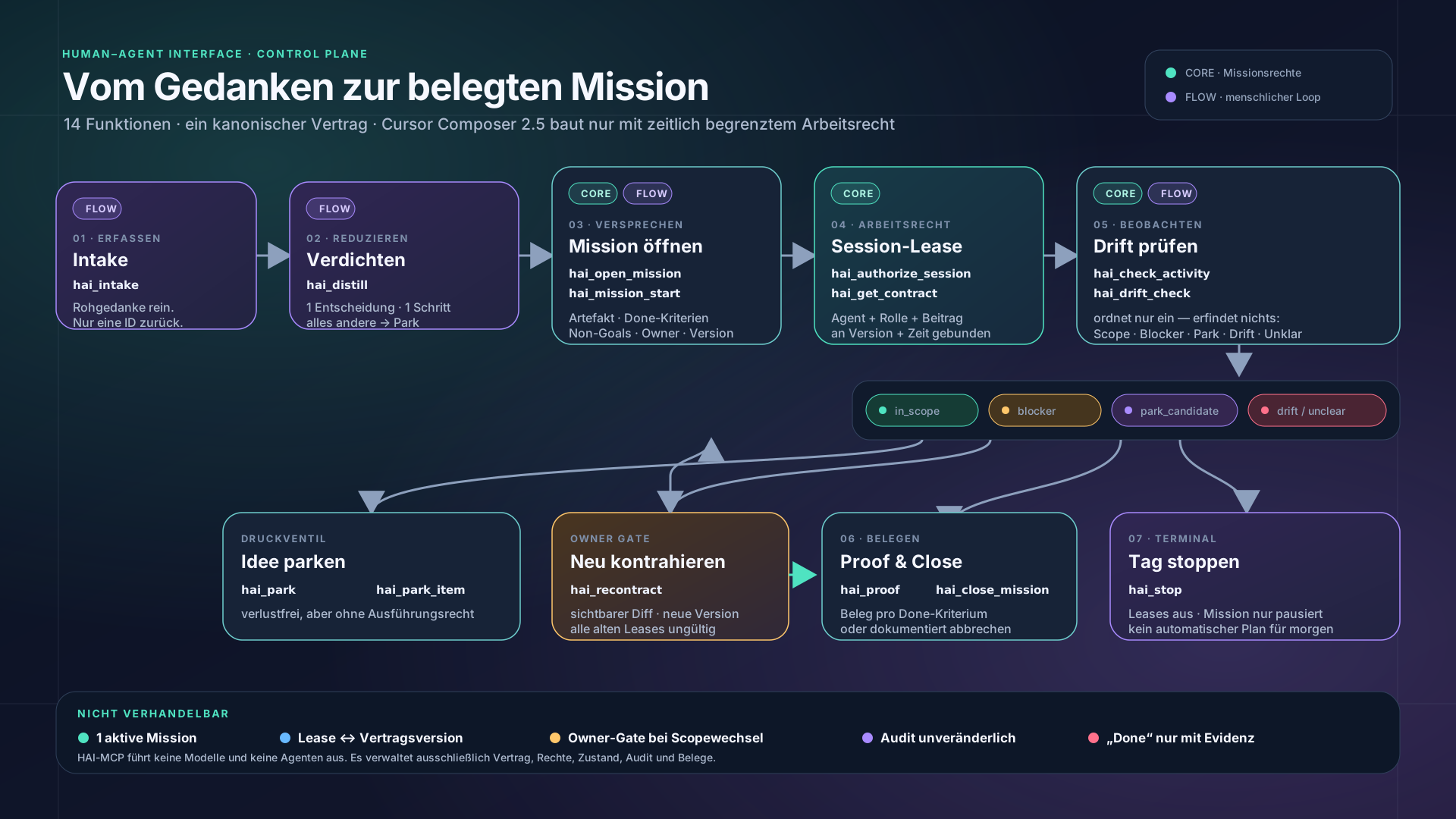
HAI-MCP · Model-agnostic MCP control-plane for the Human Agent Interface (HAI) approach


Why this repo exists
Agents are now driving shells, editors, browsers, and CI. Most of them work without a human in the loop long enough for the human to lose the thread. HAI — the Human Agent Interface — is an opinionated, evidence-based way to keep agentic work observable, bounded, owner-gated, and recoverable so a human can still own the work even when an agent is doing it.
HAI-MCP is the open-source, model-agnostic implementation of that approach. It is one of the pieces of Samuel Fleig's HAI stack — the part that any Model-Context-Protocol-speaking client can talk to, regardless of which LLM sits behind it.
Canonical site: https://www.human-agent-interface.com/ · About Samuel: https://www.human-agent-interface.com/samuel/
What "MCP control-plane" means here
MCP — the Model Context Protocol — is a standard JSON-RPC interface that lets a tool server expose tools, resources, and prompts to an LLM-backed client (Claude Code, Codex, Cursor, Grok, OpenCode, Hermes, …). The client discovers the server's tools and calls them during a conversation; the server stays stateless from the model's point of view.
A control-plane server is one that does not do the work itself — it governs how work is authorised, scoped, recorded, and handed back to the human. Concretely, an MCP control-plane:
| Concern | What HAI-MCP exposes for it |
|---|---|
| Mission contract | hai_open_mission, hai_get_contract, hai_recontract |
| Session leasing | hai_authorize_session — time-bounded, contract-versioned |
| Activity classification | hai_check_activity / hai_drift_check — on-contract vs. off-contract |
| Focus & lanes | hai_set_focus, hai_status — at most 2 ACTIVE lanes |
| Owner gate | one-time nonces out-of-band (HAI_OWNER_HOME or ntfy) for accept / recontract / abandon |
| Evidence & closure | hai_proof, hai_close_mission, hai_stop |
| Inbox & intake | hai_intake, hai_distill, hai_park, hai_park_item |
| Recovery | hai_checkpoint, hai_recover |
HAI-MCP is deliberately not an agent runtime. It never calls an LLM, never runs shell, never pushes to git, and never deletes files. It is the judge — agents call it to ask "may I?" and to record "I did".
Features
- One state engine, 23 tools — three surfaces (legacy control plane, mission lifecycle, daily-loop wrappers) sharing one hardened core.
- Strict fail-closed boundary — inputs are typed and rejected, not
coerced. A
String "2"is refused for anIntegerfield; the server stays reachable instead of silently mangling types. - Versioned mission contracts — every mission has a contract with a monotonic version. Recontracting produces a visible field-level diff and revokes every existing lease.
- Time-bounded session leases —
hai_authorize_sessionbinds a lease to a mission id, a contract version, a duration, a role, a contribution, and a claimed criterion set. - Deterministic drift check —
hai_check_activityclassifies planned or observed activity against the contract without ever calling an LLM. - Two-principal owner gate:
- Default (nonce): the server delivers a one-time code to the owner
channel (
HAI_OWNER_HOME/fileor ntfy). The client never sees the code. The code is bound to the exact change, single-use, expiring; only the hash is stored inHAI_HOME. ack_legacy: the old self-assertedowner_ackflag — an honor system, surfaced as such byhai_health.
- Default (nonce): the server delivers a one-time code to the owner
channel (
- Mount table —
hai_bind_projectjoins a logicalproject_idto a device-local directory behindowner_ack + reason. - Model-agnostic — same binary, same tools, same contract. Switch LLMs without rewriting governance.
- Two transports — stdio (default) and
streamable-httpwith optional bearer-token binding (loopback only by default). - Checkpoint & recover —
hai_checkpointsnapshots context;hai_recoverreturns the smallest recovery next action. - 139 tests green — the engine is covered; the slice remains open for the learning-budget and owner-instrument follow-ups.
Install & run
Requires Python ≥ 3.12 and uv.
git clone https://github.com/smlfg/hai-mcp.git
cd hai-mcp
uv sync --all-extras
uv run hai-mcp          # stdio transport, default
Streamable-HTTP transport:
HAI_TRANSPORT=streamable-http \
HAI_HTTP_HOST=127.0.0.1 \
HAI_HTTP_PORT=8765 \
HAI_HTTP_TOKEN="$(openssl rand -hex 32)" \
uv run hai-mcp
HTTP binding to non-loopback hosts is refused unless
HAI_HTTP_TOKENis set. Seedocs/OWNER_GATE.mdand the--helpoutput.
Sample usage — wiring the server into a client
The server is transport-agnostic; every MCP client gets the same 23 tools. Drop the snippet into the client's MCP config and restart.
Claude Code / Claude Desktop
{
  "mcpServers": {
    "hai": {
      "command": "uv",
      "args": [
        "run",
        "--directory",
        "/absolute/path/to/hai-mcp",
        "hai-mcp"
      ],
      "env": {
        "HAI_HOME": "/home/you/.hai",
        "HAI_OWNER_HOME": "/home/you/.hai-owner"
      }
    }
  }
}
Cursor
{
  "mcpServers": {
    "hai": {
      "command": "uv",
      "args": [
        "run",
        "--directory",
        "/absolute/path/to/hai-mcp",
        "hai-mcp"
      ],
      "env": {
        "HAI_HOME": "/home/you/.hai",
        "HAI_OWNER_HOME": "/home/you/.hai-owner"
      }
    }
  }
}
Codex / Hermes / any MCP stdio client
Same shape — point at the uv run --directory … hai-mcp command and pass
the two env vars. More snippets live in docs/client-snippets/.
Sample usage — driving the protocol
A typical agent loop calls HAI-MCP before it acts and after it acts.
1. Open a bounded mission
hai_mission_start(
  problem   = "Refactor the evaluator harness to be deterministic.",
  artifact  = "Pull request titled 'evaluator: deterministic harness'.",
  done_criteria = [
    {"id": "C1", "description": "Two A/B cases produce identical verdicts on three reruns."},
    {"id": "C2", "description": "Harness runs offline; no live network calls."},
  ],
  owner             = "samuel",
  time_limit_hours  = 6,
  non_goals         = ["Do not touch the MCP server.", "Do not change contract shapes."],
  constraints       = {"python": ">=3.12", "branch": "slice/eval-determinism"},
)
2. Authorise a session lease
hai_authorize_session(
  mission_id         = "<from open>",
  contract_version   = 1,
  agent_identity     = "codex-cli",
  role               = "implementer",
  contribution       = "Deterministic A/B harness",
  expected_result    = "Green pytest with frozen inputs.",
  duration_minutes   = 90,
  criterion_ids      = ["C1", "C2"],
  device_id          = "mbp-mirgraatin",
  harness_id         = "codex-cli/0.45",
)
3. Check an activity before running it
hai_check_activity(
  session_id     = "<from lease>",
  activity_step  = "Replace random.seed with a seeded fixture in tests/test_eval_ab.py",
  criterion_id   = "C1",
  affected_paths = ["tests/test_eval_ab.py", "tests/fixtures/ab/case1.json"],
)
# → {"verdict": "on_contract", ...}
4. Close with evidence
hai_proof(
  mission_id        = "<from open>",
  contract_version  = 1,
  outcome_summary   = "A/B cases produce identical verdicts on three reruns; harness offline.",
  evidence          = {
    "C1": {"command": "pytest tests/test_eval_ab.py -q", "exit_code": 0,
           "reruns": [0, 0, 0]},
    "C2": {"command": "pytest tests/test_eval_ab.py -q --offline", "exit_code": 0},
  },
)
5. Owner-gated promotion
For hai_accept_next_step, hai_recontract, or abandoning a mission, the
first call without owner_code delivers a one-time code to the owner's
channel (the file sink in HAI_OWNER_HOME, or an ntfy topic). Relaying
that code back as owner_code=<code> completes the action. The code is
bound to the exact change, single-use, and only its hash is persisted in
HAI_HOME. Detail: docs/OWNER_GATE.md.
State layout
- Global:
$HAI_HOME— default~/.hai - Owner channel:
$HAI_OWNER_HOME— default~/.hai-owner(deliberately outsideHAI_HOMEso the agent cannot read it) - Per-project:
<project_path>/Projek-Managment/(legacy) or device mount + relative prefixes when aproject_idis bound - Mount table:
HAI_HOME/core/projects.json
All writes are resolved and confined to these roots.
Project layout
hai-mcp/
├── docs/
│   ├── TOOL_CONTRACT.md      # normative tool contract (gates, errors, schemas)
│   ├── OWNER_GATE.md         # nonce + ack_legacy owner-gate spec
│   ├── BUILD_HANDOFF.md
│   ├── client-snippets/      # ready-to-paste mcp.json snippets
│   ├── eval/                 # A/B harness contract
│   ├── plans/                # dated design slices
│   └── visuals/              # mission-lifecycle banner assets
├── scripts/                  # stdio smoke + impact-eval runner
├── src/hai_mcp/              # the server
└── tests/                    # 139 tests
Limitations
HAI-MCP is intentionally narrow. It does not:
- Call any LLM. The server is dumb on purpose — governance is a separate concern from generation.
- Execute code, run shells, push git, or delete files. It refuses tools
like "commit & push", "run pytest", "rm -rf". Agents are expected to
do those things and report back via
hai_check_activity/hai_proof. - Merge with
hai-intakepackages. The intake pipeline is a separate stack; coexistence is fine, fusion is not. - Provide a UI. There is no dashboard. The control plane speaks MCP and writes JSON; visualisation is the client's job.
- Multi-mission concurrency. Exactly one active mission globally. Open a new one only after the previous is closed (completed or abandoned).
- Cross-device writes. Each device sees only its own mounts. The mount table is per-device; the contract is global.
- Forward compatibility for major MCP bumps. The server pins
mcp>=1.9.0,<2; a v2 of MCP will require a separate migration slice. - No revocation list / no kill-switch API. Lease invalidation happens
via recontract, mission close, or
hai_stop; there is no out-of-band "revoke everything right now" tool. - No automatic recovery from a corrupted
HAI_HOME. If the global state directory is corrupted, the server fails closed — by design, but recovery is manual (seehai_recover).
See docs/TOOL_CONTRACT.md for the full
gate matrix and docs/OWNER_GATE.md for the
owner-gate contract.
Tests
uv run pytest                       # full suite
uv run python scripts/stdio_smoke.py  # stdio round-trip smoke
The repo carries 139 green tests as of the 0.1.0 slice. CI status
lives on the GitHub Actions page of the repository.
Contributing
The control plane is small on purpose — additions go through a contract slice:
- Read
docs/TOOL_CONTRACT.md. - Open an issue describing the tool / gate / state change.
- Land it behind a
fail-closedslice with tests + plan indocs/plans/.
Pull requests that change gates, schemas, or the mount table without a matching plan will be asked to follow the same path.
License
MIT — see LICENSE. Copyright © 2026 Samuel Fleig.
Acknowledgements
HAI-MCP is one piece of Samuel Fleig's HAI stack. It stands on:
- the Model Context Protocol specification,
- the
mcpPython SDK (mcp>=1.9.0,<2), - and the legacy
~/.config/hai-agent-mcpHermes bridge that this server replaces for control-plane work. Coexistence is supported; the bridge is not required.
Canonical HAI site: https://www.human-agent-interface.com/ · About Samuel Fleig: https://www.human-agent-interface.com/samuel/
From the server's repository — third-party content, read it before running anything it suggests.
More in DevOps
audit-gap-auditor
io.github.GuardBee
OWASP MCP08 audit/telemetry gaps: missing tool-call logs, raw args in logs, disabled audit
dns-intelligence
io.github.GuardBee
DNS record enumeration, misconfiguration and dangling-subdomain detection
AppCrane
io.github.gitayg
Deploy and manage apps on your own AppCrane instance, the self-hosted PaaS for AI-built apps.
VMware Pilot
io.github.vmware-skills
Multi-step workflow orchestration for VMware MCP skills with approval gates and rollback.
VMware AIops
io.github.vmware-skills
AI-powered VMware vCenter/ESXi VM lifecycle and deployment with 60 MCP tools.
VMware Debug
io.github.vmware-skills
VMware incident timeline, root-cause routing, local case ledger; no vSphere access. 14 MCP tools.
Listing from the official MCP Registry · repository facts from GitHub, 14m ago.