- Language
- Shell
- Last commit
- 1h ago
- Forks
- 0
- Open issues
- 2
- Registry update
- Oct 16, 2026
Connect
npm$claude mcp add e3d-pilot \ -e E3D_MCP_MAX_ROUNDS=<e3d-mcp-max-rounds> \ -e E3D_MCP_MAX_PROVIDERS=<e3d-mcp-max-providers> \ -e E3D_MCP_MAX_CONCURRENT=<e3d-mcp-max-concurrent> \ -e E3D_MCP_TIMEOUT_SEC=<e3d-mcp-timeout-sec> \ -- npx -y [email protected]
Environment variables
E3D_MCP_MAX_ROUNDSMaximum debate rounds per call (default 3).
E3D_MCP_MAX_PROVIDERSMaximum model providers per debate (default 4).
E3D_MCP_MAX_CONCURRENTMaximum concurrent debates (default 2).
E3D_MCP_TIMEOUT_SECPer-debate timeout in seconds (default 900).
Security review
Review passedReviewed 50m ago.
- metadata
- scanned
- packages
- 1 checked
No findings.
Tools
This server runs on your machine, so its tool list is not fetched before install — the README below describes what it offers.
e3d-pilot
Multi-model AI problem solving: independent answers → critique → convergence → human decision → execution → review → provenance.
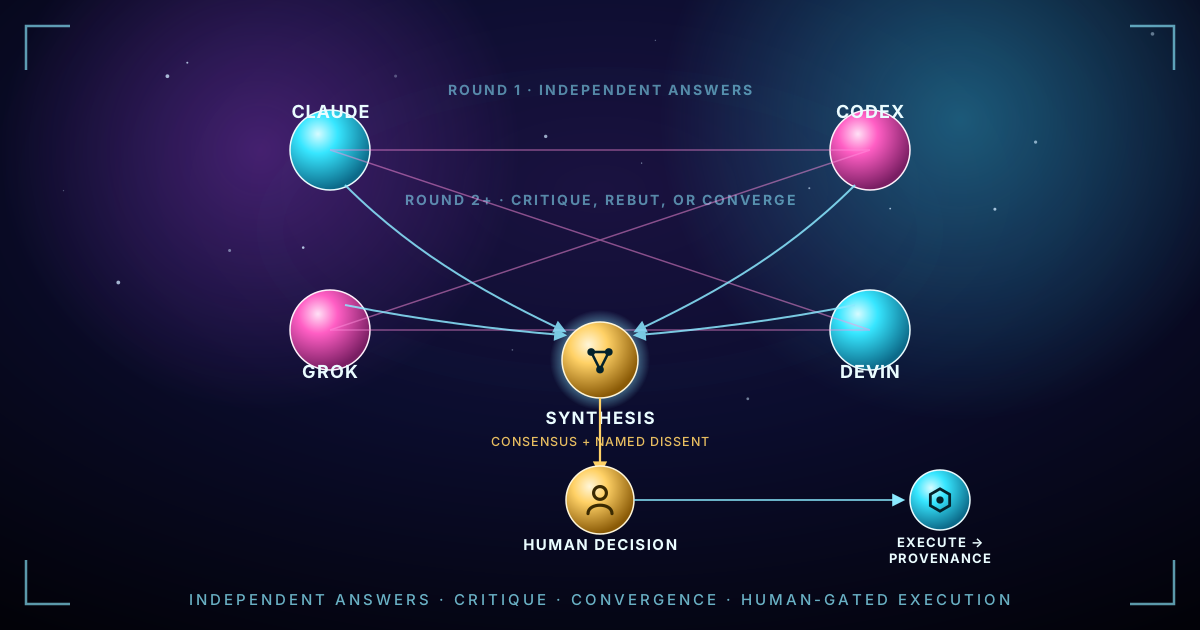
e3d-pilot is an open-source system for getting multiple AI models to work on the same problem instead of trusting a single model's answer — from a one-off question to a fully executed, human-gated software change.
It starts simply. Ask several configured models (Claude, Codex, Grok, Devin, or others you wire in) the same question. Let them answer independently, see and critique each other's positions, revise, expose real dissent, and converge on the strongest answer. That's bin/e3d-debate — a standalone tool, no repo or pipeline required. It's also available inside your editor as an MCP server: use it from GitHub Copilot, Claude Code, or Cursor with one npx line.
Then e3d-pilot takes the same instinct further, into real software work: discover → ideate → approve → draft → negotiate → execute → review → publish → outcome. Every step is preserved in an append-only ledger, so the system (or a human, or a fresh AI session) can later reconstruct where an idea came from, which models or people influenced it, what it produced, and what happened afterward.
Try e3d-debate in 60 seconds
git clone https://github.com/spacepacket1/e3d-pilot.git
cd e3d-pilot

bin/e3d-debate \
  "Should e3d-pilot's provenance data be a graph, or is that over-engineering?" \
  --providers claude,codex --rounds 3
(Any lib/providers/<name> adapter can join — add devin/grok-build/others if you have them configured; claude/codex are the two most people trying this will already have.)
Round 1: every provider answers independently. Round 2+: each sees the others' prior-round positions and must defend, revise, rebut, or concede. The debate stops early if they genuinely converge; a synthesizer then reads the full transcript and reports a final answer, consensus, and any remaining dissent.
That question isn't hypothetical — it's a real debate we ran this way, condensed from the full transcript:
QUESTION
Should the E3D 3D graph generalize into a standalone product, or should
e3d-pilot instrument its own provenance instead?

CLAUDE (round 3, the only one to formally reach "approved")
Don't create e3d-graph yet — build a confidence-annotated, domain-neutral
provenance emitter inside e3d-pilot, prove attribution questions are
answerable from the data alone, add a 2D lens only if they are, and extract
a public repo only on external pull or paid demand.

CODEX (round 3)
Build outcome-linked Pilot provenance first, then open-source a narrow
standalone viewer only if measured workflow value and external pull
justify extraction.

DEVIN (round 3)
Instrument Pilot with a domain-neutral provenance schema from day one; gate
public extraction on the internal experiment succeeding, not on indefinite
deferral.

GROK-BUILD (round 3)
Do not ship standalone e3d-graph; instrument Pilot provenance first and
treat visualization as a 2D lens inside E3D.

SYNTHESIS
Do not ship a standalone e3d-graph product. Instrument e3d-pilot now with
an append-only, domain-neutral, confidence-annotated provenance schema —
the ledger stays canonical, the graph is an index, not memory. Validate by
answering real attribution questions from the data alone before any UI.

DISSENT (reported, not hidden)
Devin and partly Codex would gate public extraction on the internal
experiment succeeding; Claude and Grok-build require external pull or paid
demand instead — a real, named disagreement the tool didn't paper over.
What happened next: we built exactly that, then ran it against three real ideas in this repo's own history. All three came back "more useful than reading the raw ledger by hand" — and one of them caught a real error in the spec that proposed it. Later graph-intelligence queries were evaluated just as honestly: one clear win, two explicitly "no signal" because the real data was still too sparse — reported as-is, not oversold. That full arc (spec, dogfood results, the honest misses) is in docs/provenance-graph-experiment.md and docs/graph-intelligence-experiment.md.
Experimental: the provenance graph. e3d-pilot now derives structural relationships — ideas, actors, models, decisions, repos, commits, evidence, outcomes — from its own immutable event ledger. We're testing whether that graph reveals patterns that are genuinely hard to get from the raw ledger, not claiming it already does.
You don't need the rest of e3d-pilot to use e3d-debate on its own — see e3d-debate below for the full flag reference. Keep reading for the part that takes a debate's answer all the way to a shipped, reviewed, provenance-tracked change.
Use e3d-pilot from GitHub Copilot, Claude Code, and Cursor (MCP)
e3d-mcp is a zero-dependency Model Context Protocol server. It lets an AI coding assistant ask for a multi-model second opinion mid-task, instead of committing to the first answer one model gives it. It's published on npm as e3d-pilot and listed in the official MCP registry as io.github.spacepacket1/e3d-pilot.
| Tool | What it does |
|---|---|
e3d_debate | Several independent models answer and a synthesizer returns a decisive answer, a consensus level (full / majority / split), any named dissent, and each model's final position, as both readable text and structured data (dissent.present, dissent.summary, positions). mode: "quick" (default) is one round and takes seconds; mode: "thorough" adds a critique round where models rebut each other. The full transcript is opt-in (include_transcript). |
e3d_list_providers | Shows which model providers are available on this machine. A debate needs at least two. |
e3d_provenance_trace | Read-only: traces why a change exists, from its origin through debates, approvals, execution, review, and outcome. |
e3d_ideas_list | Read-only: lists the ideas e3d-pilot tracks in a repo, to find an id for the trace. |
A real result in quick mode (11 seconds, two models), from asking whether a small CLI should default to a flat JSON file or SQLite:
FINAL ANSWER: Default to a flat JSON file for a small CLI. It has no dependencies, is
human-readable and diffable, and is easy to hand-edit and debug. Write it atomically
(temp file, then rename). Move to SQLite once you need indexed queries, concurrent
writers, or data beyond a few MB.
CONSENSUS: split
DISSENT: Codex prefers SQLite as the default for any persistent mutable state because
it gives transactions, concurrency safety, and schema evolution at low cost.
The disagreement is the point: you get the answer and the strongest case against it, instead of one model's confident guess.
Install
VS Code (GitHub Copilot agent mode): one-click install, or add this to .vscode/mcp.json:
{
  "servers": {
    "e3d-pilot": { "type": "stdio", "command": "npx", "args": ["-y", "-p", "e3d-pilot", "e3d-mcp"] }
  }
}
Claude Code:
claude mcp add e3d-pilot -- npx -y -p e3d-pilot e3d-mcp
Cursor (~/.cursor/mcp.json) and other clients that use the mcpServers shape:
{ "mcpServers": { "e3d-pilot": { "command": "npx", "args": ["-y", "-p", "e3d-pilot", "e3d-mcp"] } } }
Any MCP client that can launch a stdio server should work; the shapes above are each client's standard format.
Prerequisites: Node 18+, jq, bash 4+ (macOS ships 3.2: brew install bash jq), and at least two model CLIs logged in (e.g. claude and codex). Check them all at once:
npx -y -p e3d-pilot e3d-mcp --doctor
--doctor reports what's missing and how to fix it. It does not need the full pipeline's e3d-code executor (it only notes whether that is installed). From a clone, bin/e3d-mcp --print-config --local prints a config that points at your checkout.
Using it
In Copilot agent mode (or any client), ask: "Before you pick a storage layer, run e3d_debate on SQLite vs flat JSON for this CLI." To make the assistant do this unprompted for contestable design choices, copy examples/copilot-instructions.md into .github/copilot-instructions.md or AGENTS.md. Don't use it for lookups or questions with an obvious answer; it is slow and costs money.
Cost and limits
quickdebates take seconds to a minute andthoroughones a few minutes; both spend your model credits. The server capse3d_debatewithE3D_MCP_MAX_ROUNDS(3),E3D_MCP_MAX_PROVIDERS(4),E3D_MCP_MAX_CONCURRENT(2), andE3D_MCP_TIMEOUT_SEC(900).- It uses whatever provider CLIs and keys are in the server's environment (see
e3d-pilot providers list). - The Copilot coding agent runs on GitHub-hosted runners, where those provider CLIs aren't installed. Use the local (stdio) setup above for now.
- The server never writes to a repo. Recording a verdict into provenance is still
e3d-debate --repo --idea.
Why we built this
Autonomous coding agents solved the execution half of the problem: point a good model at a good spec, and it will faithfully implement it. What's still missing is everything before that — noticing what's worth building, making sure it isn't a rehash of a closed PR or last week's abandoned branch, and getting more than one model to actually agree the plan is safe and sound before anything touches a working tree. Skip that half and you get agents that happily reimplement existing features, argue with themselves in a PR nobody asked for, or quietly blow through a repo's real diff budget.
e3d-pilot exists to be that missing half: a small, auditable layer that sits above e3d-code (formerly spec2code) rather than duplicating it. e3d-code stays the dumb, reliable phase executor — "run this spec." e3d-pilot's job is deciding what the spec should even be, proving it's worth doing, and refusing to let it run unsupervised past the point where a human needs to look.
The other reason: good ideas rarely come from staring harder at the same backlog. e3d-pilot's discover stage explicitly borrows from domains outside a repo's own category — a game's progression loop, a marketplace's liquidity trick, a social feed's notification mechanics — and its ideate stage grades every candidate on attraction and retention (does this bring people in, does it bring them back) with revenue treated as a secondary tiebreaker, never the deciding factor. The goal is features people actually want, not just the next item on an internal TODO list.
A third reason, less about any single run and more about what accumulates across many of them: a decision made once shouldn't have to be re-explained from scratch to the next session that picks the work back up. Every tracked idea's ledger record is a durable, cross-session target — ideas context/ideas handoff let a fresh Claude Code, ChatGPT, or Codex session read exactly what's already known about an idea (its decisions, its findings, its current state) instead of replaying a whole prior conversation, and ideas note lets that session write back what it just learned. The same instinct — don't trust a single pass of reasoning on a genuinely contested question — is why e3d-debate exists as a standalone tool: run any question through several models across rounds until they converge or leave a named, specific dissent, the same mechanism e3d-pilot's own negotiate stage already depends on internally, available for any decision, not just code changes.
What it does differently
- Never repeats work. Every idea is checked against the target repo's open branches, its PR history (open and closed), and every prior e3d-pilot run before it's allowed to proceed.
- Never runs on one model's opinion. The negotiate stage requires every configured reviewer — two today, more later, purely via config — to independently approve the same unchanged draft. Disagreement means bounded retries, then a clean "needs human" stop, not a forced merge.
- Never treats absence of approval as approval. Discovery and ideation can run unattended, but source-mutating stages require
ideas approve, and base-branch merge requiresapprove-mergefor the exact PR head SHA. - Never touches source before the first gate. Execution happens in an isolated worktree on its own branch only after implementation approval. A path denylist and real post-execution diff ceilings are enforced before anything is reviewed or published.
- Never merges a different revision. Merge approval is separate from GitHub review approval and is bound to the observed PR URL, base branch, and head SHA. A pushed commit invalidates the approval until a human reviews and approves the new head.
- Never assumes it's talking to spacepacket1's repos. The entire contract with a target repository is one JSON config file. No fixed org, no fixed remote host, no
e3d-*naming assumptions baked into the pipeline. - Never lets an idea's context evaporate between sessions.
ideas note/ideas context/ideas handoffgive any AI session — not just e3d-pilot's own pipeline runs — a durable place to read and write what's been learned or decided about a tracked idea, independent of its lifecycle status.
How it can help others
If you maintain a repository and want a standing second opinion on "what should we build next" — one that does its homework before proposing anything, gets independent model consensus before acting, and hands you a draft PR with a full audit trail instead of a fait accompli — adopting e3d-pilot is meant to be a one-file decision: write .e3d-pilot/config.json, run it once to validate, then point it at your repo (or a whole fleet of them) on whatever cadence you choose (a cron entry, a scheduled job — e3d-pilot doesn't invent its own scheduler). It works identically on GitHub, on a remote-less local repo, and — architecturally, even before a forge adapter exists for it — on any other git host, because only the final publish step knows what forge it's talking to.
Pipeline
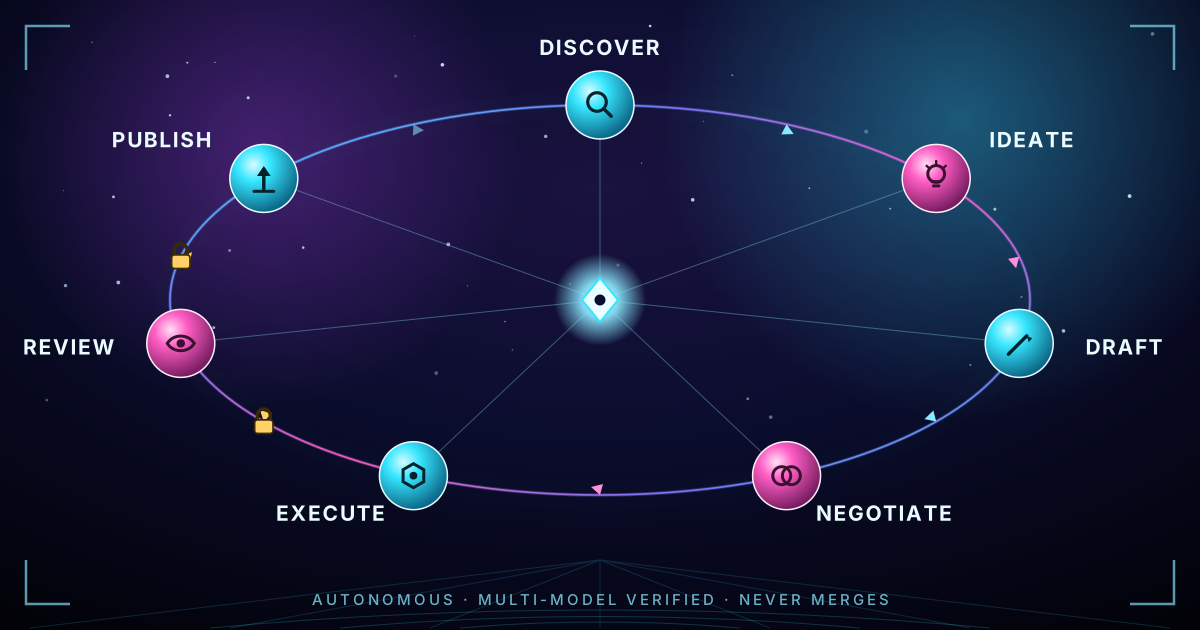
flowchart LR
    A[discover] --> B[ideate]
    B -->|optional candidate_scoring| S[read-only ensemble]
    S --> I[[proposed idea ledger]]
    B -->|selected: none| STOP1((nothing to do))
    I -->|ideas approve| C[draft]
    I -->|ideas reject| STOPR((rejected))
    C --> D[negotiate]
    D -->|needs human| STOP2((stop for review))
    D --> E[execute]
    E -->|over ceiling| STOP2
    E --> F[review]
    F -->|verify failed| STOP3((blocked))
    F --> G[publish]
    G --> H[[implemented: draft PR / local branch]]
    H -->|approve-merge for exact head SHA| M[merge]
    M --> Z[[merged / partially_merged / merge_failed]]
- discover — writes
findings.md: Git history, branches, issues/PRs, existing docs and TODOs, plus a model-researched "External Context" section that includes an explicit cross-domain "Analogous Patterns" subsection (see Ideation sourcing below). - ideate — writes ranked, deduplicated
candidates.mdand materializes every non-duplicate candidate as aproposedidea.selected: noneis a valid, clean stop when everything proposed is already covered. Ifcandidate_scoringis configured, an ensemble of read-only workers re-ranks non-duplicate candidates before materialization; the original model pick is stored asmodel_selected. - approval gate 1 — a human approves or rejects the exact idea.
proposednever means rejected, and no source-mutating stage can run without current implementation approval. - draft — turns the approved candidate into an e3d-code-shaped
spec-draft.md, with machine-readablepilot:touchesannotations per phase so later guards can check real paths instead of guessing from prose. - negotiate — every configured reviewer must approve the same unchanged draft in one pass; disagreement drives bounded revision rounds, ending in
spec-final.mdon success or a clean "needs human" stop. - execute — hands
spec-final.mdto the configured execute backend inside an isolated worktree on its own branch, then enforcesprotected_pathsand the real post-executionmax_diff_files/max_diff_linesceilings. The default backend is e3d-code (formerly spec2code).providers.execute: "grok-build"is an experimental alternative that still uses the same worktree, ceilings, review, and draft-PR path. - review — runs (or auto-detects) verification commands and asks an independent review provider to inspect the actual diff.
- publish — only after verification passes: commits the run's audit artifacts to the branch and hands off to a publish backend (
githuborlocal) to open a draft PR or leave a local review branch. - approval gate 2 — a human runs
approve-mergeafter reviewing the draft PR/local branch. For GitHub targets, e3d-pilot records the current PR head SHA and refuses to merge any later head without a new approval.
Generated run artifacts live under .e3d-pilot/runs/<run-id>/ in the target repository. Idea ledger state lives under .e3d-pilot/ideas/<idea-id>/idea.json, with append-only events in .e3d-pilot/events.jsonl. idea.json is derived from events and can be rebuilt; events.jsonl is the immutable audit source. discover and all without --run-id start a new, collision-safe run-id and update .e3d-pilot/latest-run; every other stage resumes that latest run-id unless you pass --run-id <id> explicitly. Create .e3d-pilot/paused in a target repo to stop stages before any external work happens.
Ideation sourcing and scoring
Discover's model call doesn't just summarize "state of the art" — it's asked to pick the 2-3 most transferable entries from a configurable analogy_domains list (or a sensible built-in default spanning games, social platforms, marketplaces, dev tools, and fintech) and name, concretely, how each mechanic could apply to this repo.
Ideate then scores every non-duplicate candidate on Attraction and Retention (1-5 each), tags a Category (data, workflow, social, gamification, testing, marketing, selling, or other), cites the Analogy it drew on, and estimates Effort. Ranking is driven primarily by Attraction + Retention; an optional Revenue score can only break ties between otherwise-equal candidates — it can never outrank a candidate that attracts or retains users better. That priority order is deliberate: growing and keeping users is the point, revenue is a secondary outcome of doing that well.
Semantic duplicate detection (Jev, optional)
Exact-duplicate candidates are already caught by hashing the proposal (ideas_find_duplicate_by_digest) before materialization. Separately, if TYPESAFE_API_KEY is set, every newly materialized idea is checked against the other live ideas in the same ledger via Jev (TypeSafe's System One Choice API) for a semantic duplicate — same underlying gap, different wording — that hashing can't catch. This runs automatically on every ideas ingest/propose call; no config flag turns it on beyond the credential being present, and its absence is a silent no-op, not an error.
It is shadow-mode and advisory-only: a match never blocks ingest or changes the candidate, it only appends a finding note ("possible semantic duplicate of <idea-id>, confidence <level> — does not block this idea") for a human to read during review. It stays advisory until a real calibration sample validates Jev's false-positive rate on this specific judgment (see idea-980bf5b4df6b / idea-82a5c2225266). See lib/ideas/jev_dedup.sh.
Optional ensemble scoring
After the ideate provider writes candidates, an optional candidate_scoring block can re-rank them with 3–5 independent read-only workers before ideas are materialized. The original model pick is stored as model_selected; selected becomes the ensemble winner among non-duplicate candidates. Scoring never executes, publishes, or approves — the two human gates still apply.
Any lib/providers adapter can be the scoring provider. grok-build is one option, intended as a cheaper fan-out in front of frontier negotiate and e3d-code execute:
"candidate_scoring": {
  "provider": "grok-build",
  "workers": 3
}
workers must be an integer from 3 to 5 (default 3). Artifacts land in the run directory as ideate-scoring.json, ideate-response.model.md, and per-worker prompts/stdout under ideate-scoring.artifacts/. Fleet discover uses the same block in .e3d-pilot-fleet/config.json, writing fleet-ideate-scoring.json. Each idea record stores the ensemble average as scores.ensemble when scoring ran; that field is not part of the approval digest.
Revenue-focused runs
Pass --focus revenue to e3d-pilot run (any stage) to flip that priority for a dedicated pass: discover adds a ### Monetization Signals subsection (existing monetization mechanisms in the repo, plus 2-3 adjacent-industry models that could extend them), and ideate ranks candidates by Revenue first — Attraction/Retention only break ties, and Revenue becomes a required numeric field instead of an optional tiebreaker. Candidates may be net-new monetization surfaces, not just extensions of existing features; duplicate-checking still applies equally either way.
Focus is resolved once per run and persisted to .e3d-pilot/runs/<run-id>/focus, so a later stage of the same run (e.g. a standalone --stage ideate invocation after discover already ran) inherits it automatically unless --focus is passed again explicitly, which overwrites it. Default behavior (--focus default, i.e. attraction/retention-first) is unchanged.
Fleet live operations
Fleet discovery can surface two read-only operational signals from optional .e3d-pilot-fleet/config.json fields:
live_instances: an array of objects with exactlynameandurl.namemust be a non-empty display string.urlmust be a non-emptyhttp://orhttps://URL with a non-empty authority and no userinfo. The collector makes exactly oneGETrequest per instance, follows at most one redirect, caps each request at 10 seconds, allows only HTTP/HTTPS on initial and redirected requests, and never retries.- Live classification is deterministic:
healthymeans HTTP 200 at or below 1500 ms;degradedmeans HTTP 200 above 1500 ms or any other 2xx/3xx response;downmeans curl failure, invalid elapsed/status output, or any non-200-399 status, including 000, 1xx, 4xx, 5xx, and 6xx-9xx. social_accounts: an array of objects with exactlyplatform,name,channel_id, andbot_user_id.platformmust be the stringdiscord.bot_user_idis a public exact-authorship identifier, not a credential. Discord collection readsDISCORD_BOT_TOKENfrom the environment, makes exactly one messages request per credentialed account, and makes zero requests when the token is missing or empty.- Discord collection is read-only and uses
GET https://discord.com/api/v10/channels/{channel_id}/messages?limit=50with no retries. It distinguishesno recent messages found, zero-engagement messages, and collection failures. Reactions are summed only for messages whoseauthor.idexactly matchesbot_user_id. ## Live Operationsis appended only when at least one of those arrays is non-empty.### Live Instance Statusappears first whenever the section is present; if there are no live instances but Discord is configured, it saysNo live instances configured.### Social Engagementappears only whensocial_accountsis non-empty.### Operational Recommendationsis included only for degraded/down live instances and Discord zero-engagement or collection-failure bullets, in configuration order. It repeats the exact observed state and does not guess a cause. Healthy instances, nonzero Discord engagement, andno recent messages founddo not get recommendations.- Moltbook support is planned as a later sibling branch.
- Keep credentials out of fleet config; only
DISCORD_BOT_TOKENbelongs in the runtime environment.
Start from examples/sample-fleet-config-with-ops.json if you want a ready-made fleet config with fictional .example.com live instances and a fictional Discord account.
Requirements and installation
Install Bash, Git, jq, and curl; the full pipeline's execute stage also needs e3d-code (formerly spec2code; the debate and MCP tools do not). Install and authenticate whichever model CLIs and forge CLI your configuration uses (claude, codex, devin, a local OpenAI-compatible endpoint, and/or grok for grok-build). Add this repository's bin directory to PATH:
# From npm (also installs e3d-code, the execute-stage dependency, when it can):
npm install -g e3d-pilot
e3d-pilot --help

# Or from a clone:
git clone https://github.com/spacepacket1/e3d-pilot.git
export PATH="$PWD/e3d-pilot/bin:$PATH"
e3d-pilot --help
The npm package provides three commands: e3d-pilot, e3d-debate, and e3d-mcp.
Node.js is only needed for the optional e3d-pilot web dashboard (see Web UI below) — every other command needs only Bash, Git, jq, and curl.
Configure a repository
Create .e3d-pilot/config.json in the target repository. Start from examples/sample-config.json. The fields are:
verify: commands run in the execution worktree before publish. An empty list is auto-detected frompackage.json,requirements.txt, orMakefile.protected_paths: globs that generated specs and execute-time guards reject.research_topics: hints for discovery research.analogy_domains: optional cross-domain seed list for discovery's analogy pass (see above); falls back to a built-in default when omitted.providers: provider names fordiscover,ideate,draft, orderednegotiatereviewers, independentreview, and optionalexecute(e3d-codeby default, or experimentalgrok-build).discover,ideate,negotiate, andreviewmay be a string or an array of provider names; when an array is set, every listed model runs (discover/review concatenate their output; ideate merges candidates; negotiate still requires one unchanged-draft consensus pass).draftremains a single provider.grok-buildis a normal adapter: put it in the same fields you would use forclaude,codex,devin, orlocal.candidate_scoring: optional{ "provider": "grok-build", "workers": 3 }. After ideate proposes candidates, 3–5 independent read-only workers re-rank them.provideris anylib/providersadapter;grok-buildis one option. Scoring never executes, publishes, or approves. Omitted means no scoring.max_diff_filesandmax_diff_lines: actual post-execution ceilings.docs: optional guidance-document path; otherwise common filenames are detected.live_verify: optional{ "command": "..." }hook. It runs only when repository docs identify a supported E3D paid-API surface ande3d-agentis available; otherwise it is skipped.pr:base_branch, draft flag, labels, and backend (auto,github, orlocal).notify: optional{ "email": { "to": "...", "command": "..." } }. See Notifications.approval: optional{ "implementation_required": bool, "merge_required": bool }. Both default totrue; see Approval-gated operator workflow.tracking: optional{ "project_url": "..." }. OverridesE3D_PILOT_TRACKING_PROJECT_URLfor this repo; see Project board tracking.
Validate and run:
e3d-pilot config validate /path/to/repository
e3d-pilot run --repo /path/to/repository --stage all
Approval-gated operator workflow
The default run --stage all discovers and ideates autonomously, materializes ideas, then stops before draft unless the selected idea already has current implementation approval. This is a successful waiting state, not a crash.
List and inspect proposed ideas:
e3d-pilot ideas list --repo /path/to/repository --status proposed
e3d-pilot ideas show --repo /path/to/repository idea-abc123def456
Approve or reject implementation:
e3d-pilot ideas approve --repo /path/to/repository idea-abc123def456 --actor [email protected] --note "Build this next"
e3d-pilot ideas reject  --repo /path/to/repository idea-abc123def456 --reason "Not aligned this cycle" --actor [email protected]
ideas approve is the first gate. It authorizes drafting, negotiation, execution, review, and publication for the exact idea content and approved target plan. It is not a GitHub PR review, and it does not authorize merge.
Record findings and decisions on an idea, and pull them back out as compact context, independent of the idea's lifecycle status:
e3d-pilot ideas note     --repo /path/to/repository idea-abc123def456 "Discovered the API rate-limits at 50 req/min" --actor [email protected]
e3d-pilot ideas note     --repo /path/to/repository idea-abc123def456 --decision "Ship the read-only slice first" --actor [email protected]
e3d-pilot ideas context  --repo /path/to/repository idea-abc123def456 [--json]
e3d-pilot ideas handoff  --repo /path/to/repository idea-abc123def456
These exist to close one specific gap: nothing outside e3d-pilot's own pipeline invocations ever writes to .e3d-pilot/, so context discovered in an ad hoc Claude Code, ChatGPT, or Codex session about a tracked idea has nowhere durable to go. ideas note appends a freeform finding (or, with --decision, a decision) to the idea's existing ledger record via a pure self-loop event (note_appended) that never gates and is never gated by lifecycle status — it works on an idea in any state, including proposed, implemented, or merged. ideas context reads that idea back as a short summary plus its accumulated decisions and findings, separated. ideas handoff renders the same information as a compact packet (GOAL / STATUS / RELEVANT DECISIONS / RELATED CONTEXT / RECENT FINDINGS) sized to hand to a fresh model session instead of re-explaining everything from scratch. None of this adds a new schema or a new idea type — it's three thin verbs over the existing per-idea ledger.
Provenance export and trace experiment
The provenance commands derive a disposable graph or a single-idea trace directly from the same event ledger:
e3d-pilot provenance export --repo /path/to/repository [--out /path/to/provenance.jsonl]
e3d-pilot provenance trace  --repo /path/to/repository idea-abc123def456 [--json]
e3d-pilot fleet provenance export /path/to/fleet.json [--out /path/to/provenance.jsonl]
e3d-pilot fleet provenance trace  /path/to/fleet.json idea-abc123def456 [--json]
provenance export regenerates canonical nodes and edges, including the repositories a fleet idea proposed; provenance trace reads events.jsonl directly and separates decisions, findings, work Pilot produced, external commits it merely observed, outcomes, and failures. Add --evidence <path-or-url> to ideas note to retain a pointer to supporting material in repo-mode traces and exports without copying that material into the ledger. This is the deliberately UI-free experiment agreed in the e3d-graph debate: validate that the trace answers real attribution questions faster and more accurately than reading the ledger by hand before doing any visualization work.
Every provenance export also writes a sibling <name>.manifest.json (node/edge counts by type, orphan nodes, the highest-degree node, and a graph_events_ratio of derived graph size against source ledger size) — engineering telemetry to catch the graph quietly bloating or losing structure, not product analytics.
The fixed provenance query subcommands summarize idea-to-outcome lineage, repeated review reversals, implementation failures, and fleet-only cross-repo propagation; each supports --json, fleet mode uses e3d-pilot fleet provenance query <name> /path/to/fleet.json, and repo mode uses e3d-pilot provenance query <name> --repo /path/to/repository (where cross-repo intentionally returns an empty result).
A separate, standalone script — bin/e3d-provenance-agreement --repo /path/to/repository (same not-wired-into-the-subcommand-tree pattern as e3d-debate) — aggregates provider agreement across that repo's historical negotiate and review rounds under .e3d-pilot/runs/, reusing the existing lib/negotiate/parse-status and lib/review/parse-verdict parsers as subprocesses rather than re-deriving their contract. It prints JSON on stdout: each provider's negotiate approval rate, each provider-pair's agreement rate, and the specific disagreements (run ID, round, both providers' status and stated reason). Response files that predate the current format or fail to parse are skipped and counted separately, never counted as either agreement or disagreement.
Implement approved ideas:
e3d-pilot ideas implement --repo /path/to/repository idea-abc123def456
e3d-pilot ideas implement-approved --repo /path/to/repository
Successful implementation records the run ID, branch/worktree, changed files and lines, verification results, review result, publish backend, PR URL/number, and final PR head SHA. GitHub publication creates a draft PR; local publication leaves a local review branch and summary.
ideas implement always starts a brand-new run and redoes draft, negotiate, and execute from scratch on retry — including when only the last stage (typically publish, e.g. a forge label that didn't exist yet) failed on an otherwise fully verified and reviewed attempt. If a specific run already got that far, resume it in place instead of paying for another draft/negotiate/execute cycle:
e3d-pilot ideas repair-run --repo /path/to/repository --run-id <run-id> [--from-stage <stage>] idea-abc123def456
--from-stage defaults to publish. Every stage strictly before the resume point must already have its real success artifact on disk — this can only skip work that's provably already done, never work that never happened.
After reviewing the draft PR, approve and perform merge with the second gate:
e3d-pilot ideas approve-merge --repo /path/to/repository idea-abc123def456 --actor [email protected] --note "Reviewed head"
e3d-pilot ideas merge         --repo /path/to/repository idea-abc123def456
approve-merge records the exact PR URL, base branch, and head SHA. ideas merge refreshes forge state immediately before merging and refuses stale heads, changed base branches, draft PRs, closed PRs, or missing approvals. A GitHub review approval is useful social evidence, but it is not an e3d-pilot merge approval.
Request changes, sync forge state, and record outcomes:
e3d-pilot ideas request-changes --repo /path/to/repository idea-abc123def456 --reason "Tighten scope"
e3d-pilot ideas sync            --repo /path/to/repository
e3d-pilot ideas outcome         --repo /path/to/repository idea-abc123def456 --window 7d --metric retained=true --metric revenue=42
e3d-pilot ideas rebuild         --repo /path/to/repository
sync observes PR head changes, draft/ready changes, checks, closures, and external merges without approving anything. A new PR head invalidates merge approval. outcome appends typed metrics; it never overwrites history. rebuild rematerializes derived idea.json snapshots from events.jsonl.
Migration
Existing .e3d-pilot/runs/<run-id>/ artifacts remain readable. A legacy selected candidate can be materialized as a proposed idea by rerunning ideation for that run:
e3d-pilot run --repo /path/to/repository --stage ideate --run-id <legacy-run-id>
That command may create a proposed idea record, but it never creates implementation approval. A human must still run ideas approve.
Existing open e3d-pilot PRs should be adopted only through an explicit adoption command when one is available for your installed version. Adoption must record provenance for the PR/run, start the idea at implemented, and still require approve-merge before any base-branch merge. Do not treat an open PR, a GitHub review approval, or a branch name as ledger approval.
Providers and negotiation
Built-in adapters are claude, codex, local, devin, grok-build, and
the opt-in gemini trial adapter; check them with e3d-pilot providers list.
grok-build is selected the same way as the others: name it in providers.*.
It is available when the grok binary is on PATH (override with
GROK_BUILD_BIN).
discover, ideate, negotiate, and review can each list more than one
model so every configured adapter gets a turn. A string is still valid and
means “only this one.” negotiate already worked this way; discover, ideate,
and review now do too. If one discover/ideate/review adapter is missing or
fails, the others still run and the stage continues; the stage only fails if
every listed adapter fails. Negotiate still fails fast on an unavailable
reviewer, because consensus is the point of that stage.
grok-build — shells out to the Grok Build CLI in headless mode. Reasoning
stages use the read-only sandbox. Install with
curl -fsSL https://x.ai/cli/install.sh | bash, then grok login --device-auth
or XAI_API_KEY. Override the binary, timeout, or model with GROK_BUILD_BIN,
GROK_BUILD_TIMEOUT (seconds, default 900), and GROK_BUILD_MODEL. There is
no extra enable flag: naming grok-build in config is the opt-in, the same as
the other adapters.
gemini — an opt-in trial adapter, intended for an explicitly selected
e3d-debate --providers ...gemini... run. It is absent from e3d-debate's
defaults and from every default or recommended providers.* configuration;
like every other adapter here, there is no separate enable flag beyond
naming it explicitly, so nothing in code stops it from also being named in a
pipeline stage's own providers.* config, but its shared, quota-limited free
tier (see below) makes it a poor fit for any stage that must always succeed.
Install the Gemini CLI
and follow its personal Google OAuth instructions.
The adapter rejects API-key, Vertex AI, Google Cloud, credential-override,
missing, ambiguous, and overage-billable authentication instead of risking a
paid call -- settings.json's billing.overageStrategy must be exactly
"never" (its own default is "ask", not "never"). It runs
headlessly with all built-in, extension, and MCP tools denied by policy, and
also refuses to run if any Gemini CLI hook, mcpServers entry,
admin.mcp.config, admin.mcp.requiredConfig, or adminPolicyPaths entry
is configured in the user, system-settings, or system-defaults settings
file (hooks execute arbitrary commands with prompt access at lifecycle
events; MCP servers -- including enterprise-admin-required ones, which
Gemini CLI documents as injected "regardless of user preferences" -- launch
a command at CLI startup during discovery; admin policy paths point at
additional policy files this adapter cannot audit -- all independent of the
tool-calling path the policy denies). Set
GEMINI_BIN (default gemini), GEMINI_MODEL (unset by default),
GEMINI_TIMEOUT (seconds, default 120), or GEMINI_TOKEN_LIMIT (default
200000) to override its limits. Successful calls report the exact response
model and tokens when Gemini supplies both, with unmeasured telemetry otherwise;
the timeout and token ceiling fail the call rather than returning partial output.
See the motivating Gemini/Qwen provider debate.
To use Grok only as a cheap candidate ranker, keep your existing
ideate/negotiate providers and add candidate_scoring (see
Optional ensemble scoring). That fan-out never
executes. Human approval, negotiate, and e3d-code execute stay in place.
devin — shells out to the Devin CLI in non-interactive print mode. Defaults to claude-sonnet-4-6-thinking-1m; override with environment variables:
export DEVIN_BIN=devin                          # binary path (default: devin)
export DEVIN_MODEL=claude-sonnet-4-6-thinking-1m  # model override
export DEVIN_PERMISSION_MODE=auto               # permission mode (default: auto)
local — calls an OpenAI-compatible endpoint. Useful for a self-hosted model (e.g. Qwen via Ollama) as a third negotiate reviewer:
export LOCAL_MODEL_ENDPOINT=http://localhost:11434/v1
export LOCAL_MODEL_NAME=my-model
Then add "local" anywhere in providers.negotiate; reviewer count is not hardcoded. A configured unavailable reviewer fails fast and is never silently skipped.
Every real call through the local adapter serializes through a machine-wide lock (a mkdir-based mutex at ${TMPDIR:-/tmp}/e3d-pilot-qwen.lock, override with LOCAL_MODEL_LOCK_DIR) so that two e3d-pilot runs — even against different target repos, from cron or fleet mode — never hit a shared local model endpoint at the same moment. This matters because a local endpoint is typically one memory-resident model process backing multiple repos' agents; concurrent requests to it risk OOM, not just contention. A run waits up to LOCAL_MODEL_LOCK_TIMEOUT seconds (default 900) for the lock before failing; a stale lock left by a killed process is detected and reclaimed automatically.
A negotiate reviewer that omits the optional reason: field gets a synthesized "(no reason provided by reviewer)" rather than failing the parse — small models that produce a valid status: line but drop the reason field are tolerated.
The execute stage defaults to e3d-code, which currently dispatches
Codex and Claude. An experimental providers.execute: "grok-build" path runs
Grok directly inside the same approval-gated isolated worktree. e3d-code remains the
recommended executor. See Grok Build integration and benchmarks.
Publishing
auto selects github for a github.com origin and local otherwise. GitHub pushes only the run branch and calls gh pr create --draft; it never merges or pushes the base branch. Local commits the worktree branch without network access and writes publish-summary.md. The scripts in lib/publish/ share the extension seam for a future GitLab backend.
Only after verification passes, publish force-adds findings, candidates, negotiation log, final spec, and e3d-code manifest under the run's audit path so summary links resolve on the branch. Labels configured in pr.labels are applied to the GitHub PR at creation time.
Notifications
Once a run publishes — a new branch (and, on GitHub, a draft PR) now exists and is ready for a human to look at — e3d-pilot can send a best-effort email so you don't have to go check. It's opt-in: add notify.email to the target repo's config and nothing else changes.
"notify": {
  "email": {
    "to": "[email protected]"
  }
}
The email's subject names the branch (and calls out when the outcome needs-attention, e.g. no gh available for a GitHub repo); the body is the PR URL or local branch/path followed by the same summary that goes into the PR body — findings excerpt, the selected candidate and why it wasn't a duplicate, the negotiation outcome, and links to every audit artifact.
By default it shells out to mail -s "$E3D_PILOT_EMAIL_SUBJECT" "$E3D_PILOT_EMAIL_TO" with the body on stdin. Override notify.email.command to use sendmail, msmtp, or a script that calls SES/SendGrid/etc. — same env vars, any transport:
"notify": {
  "email": {
    "to": "[email protected]",
    "command": "msmtp \"$E3D_PILOT_EMAIL_TO\""
  }
}
If notify is absent, or no mail command is configured or found on PATH, publish still succeeds — the notification step degrades to a no-op (or a one-line warning) rather than failing the run.
Project board tracking
Ideas otherwise only live in the local ledger (ideas list/show) until they reach a PR — there's no visibility into what's proposed or approved unless someone goes and asks. Point e3d-pilot at a GitHub Projects (v2) board and it keeps a card for every idea in sync with its actual lifecycle status, from the moment it's proposed through merge:
| Idea status | Board column |
|---|---|
proposed | Backlog |
approved_for_implementation, changes_requested, implementation_failed | Ready |
implementing | In progress |
implemented, approved_for_merge, partially_merged, merge_failed | In review |
merged | Done |
rejected, closed, reverted | archived (not deleted) |
It's opt-in and off by default. Set it once for every repo via an environment variable (same shape as LOCAL_MODEL_ENDPOINT — one setting, everywhere):
export E3D_PILOT_TRACKING_PROJECT_URL="https://github.com/users/<owner>/projects/<n>"
or per-repo in .e3d-pilot/config.json (overrides the env var for that repo):
"tracking": {
  "project_url": "https://github.com/orgs/<org>/projects/<n>"
}
A proposed idea gets a draft card. Once it reaches a real PR, e3d-pilot reuses an existing board item for that PR if one is already there — including one a project's own "auto-add" workflow created — rather than leaving a stale draft alongside it. Every sync is best-effort: a misconfigured URL, missing project/read:project gh auth scope, or a transient API error degrades to a stderr warning, never a failed command. Tracking state is recorded as part of the same append-only ledger everything else uses, so ideas rebuild never loses which board item an idea is linked to.
Fleet mode
Provide a JSON array of repository paths:
e3d-pilot fleet examples/sample-fleet.json
Each repository runs independently. Fleet continues after failures, prints a per-repository result and final totals, and exits nonzero if any repository failed.
Cross-repo ideation
e3d-pilot fleet <repos.json> is deliberately blind to opportunities that span repos — each one runs its own isolated pipeline. e3d-pilot fleet discover is the complement: a single portfolio-level discover+ideate pass across every repo in the fleet file at once, looking specifically for ideas that only make sense because 2+ of those repos exist together (e.g. one repo's data feed combined with another's payment rails). It never proposes anything that a single repo could do alone — that's what regular fleet/run are for.
e3d-pilot fleet discover examples/sample-fleet.json
e3d-pilot fleet discover examples/sample-fleet.json --focus revenue
It needs its own small config — providers.discover and providers.ideate, plus optional candidate_scoring (see examples/sample-fleet-config.json) — at .e3d-pilot-fleet/config.json next to the fleet file, or pass --config <path> to point elsewhere. Output lands under .e3d-pilot-fleet/runs/<run-id>/findings.md and candidates.md, mirroring the single-repo run layout: findings.md has a per-repo ## Portfolio digest (README/AGENTS/CLAUDE content, head sha) and a model-researched ## Cross-Repo Context section; candidates.md ranks candidates the same way single-repo ideate does, except every candidate must name 2 or more repos in a Repos: field, and dedup is checked only against prior fleet discover runs in the same workspace — not against each individual repo's own branches or PRs, which is a real scope limit worth knowing about.
This stage stops after materializing fleet ideas in .e3d-pilot-fleet/ideas/, with events in .e3d-pilot-fleet/events.jsonl. Cross-repo implementation still requires explicit approval:
e3d-pilot fleet ideas examples/sample-fleet.json list --status proposed
e3d-pilot fleet ideas examples/sample-fleet.json show idea-abc123def456
e3d-pilot fleet ideas examples/sample-fleet.json approve idea-abc123def456 --actor [email protected]
e3d-pilot fleet ideas examples/sample-fleet.json implement idea-abc123def456
e3d-pilot fleet ideas examples/sample-fleet.json implement-approved
A fleet idea records ordered per-repo targets at approval time. Targets are implemented sequentially. If some targets merge and a later target fails or changes, the fleet idea becomes partially_merged; e3d-pilot records which repositories merged and which did not. It never claims cross-repo atomicity.
Reviewing fleet improvements
After a fleet run, fleet prs gives you a terminal view of open e3d-pilot draft PRs across repos. Use it for visibility, not as the approval workflow:
e3d-pilot fleet prs ~/e3d-fleet.json
repo                    PR     state  idea                                          A   R   effort
────────────────────────────────────────────────────────────────────────────────────────────────
e3d-docs                #1     DRAFT  In-docs "Ask the Docs" AI assistant           5   5   high
e3d-sdk                 #1     DRAFT  MCP-native tool bindings for AI agents        5   4   high
e3d-trade               #1     DRAFT  Trade Decision Receipts                       4   5   medium
  └─ https://github.com/spacepacket1/e3d-sdk/pull/1
If ~/e3d-fleet.json exists it is used by default; pass an explicit path otherwise.
Recommended fleet approvals use the idea ledger:
e3d-pilot fleet ideas ~/e3d-fleet.json approve-merge idea-abc123def456 --actor [email protected]
e3d-pilot fleet ideas ~/e3d-fleet.json merge idea-abc123def456
e3d-pilot fleet ideas ~/e3d-fleet.json merge-approved
fleet ideas approve is implementation approval. fleet ideas approve-merge is merge approval for the exact reviewed head SHA. A GitHub review approval or fleet prs --approve action must not be treated as either ledger approval.
Web UI (optional)
fleet prs and ideas list cover the terminal; e3d-pilot web is an optional dashboard for reviewing and deciding on ideas across one or more repos in a browser, for anyone who's fine adding Node.js for it. It is not required — every other e3d-pilot command needs only Bash, Git, jq, and curl, and e3d-pilot web refuses to start with a clear error if Node isn't on PATH.
export E3D_PILOT_WEB_AUTH_USER=you
export E3D_PILOT_WEB_AUTH_PASS='a real secret, not this'
e3d-pilot web --repo /path/to/repo-a --repo /path/to/repo-b --port 4173
Open http://127.0.0.1:4173 (basic auth, the credentials above) to see every configured repo's own idea ledger merged into one filterable list, and a detail page per idea with its summary, scores, dedup rationale, approval/merge state, event history, linked run artifacts, and action buttons (approve, reject, request changes, approve-merge, sync, implement). Every action is a thin, synchronous shell-out to the exact same e3d-pilot ideas ... subcommand you'd type yourself — the web UI never reimplements ledger or approval logic, so it can never drift from the CLI's guarantees.
Clicking Implement spawns e3d-pilot ideas implement as a detached background process (draft → negotiate → execute → review → publish can take 30+ minutes) and the idea page live-tails its implementation-stage-log.md while it runs.
Both E3D_PILOT_WEB_AUTH_USER and E3D_PILOT_WEB_AUTH_PASS are required; there is no unauthenticated mode. This is meant to run on a trusted machine or behind your own reverse proxy/tunnel — it has no built-in TLS, rate limiting, or multi-user accounts.
e3d-debate (experimental)
Want this inside your editor?
e3d-debateis also exposed as an MCP tool for Copilot, Claude Code, and Cursor.
bin/e3d-debate is a separate, standalone script — not wired into bin/e3d-pilot's subcommand tree or config.schema.json, the same way bin/e3d-backend-benchmark and bin/e3d-grok-workers already aren't — for the "ask several models a question and see whether they actually agree" loop, applied to any question rather than repo work specifically. It reuses the same lib/providers/<name> adapters and the lib/negotiate/convergence primitive that discover/ideate/negotiate/review already depend on. "Experimental" here means still standalone, not wired into the pipeline proper — not unused or untested: tests/phase34.sh covers the provenance-linking flags below, and it has already been the deciding mechanism behind several real architecture and product-direction calls for this project, not just a demo.
bin/e3d-debate "Should this service store timestamps as UTC or local time+offset?" \
  --providers claude,codex,devin,grok-build --rounds 3
Round 1: every listed provider answers independently. Round 2+: each provider sees every other provider's prior-round answer and is asked to restate its position, rebut, or concede, ending with POSITION: <one-line answer> and status: approved|revise — "approved" means a person acting on this answer and a person acting on every other participant's current answer would do the same thing; added nuance or extra caveats don't count as disagreement. Once every provider reports approved, lib/negotiate/convergence stops the debate early instead of burning the remaining rounds. After the last round (early-stopped or not), one designated --synthesizer (default claude) reads the full transcript and produces a FINAL ANSWER / CONSENSUS / DISSENT summary.
Any lib/providers adapter can take part, including devin — useful if a Devin/Windsurf subscription would otherwise sit unused. The full transcript (prompts, every round's raw responses, and the synthesis) is written to a temp directory by default, or to --out-dir <path> if given.
By default a debate's verdict goes nowhere but stdout/the transcript file — it isn't wired into any repo's provenance graph. Pass --repo <path> --idea <idea-id> (both required together, plus --out-dir pointed somewhere inside --repo, e.g. docs/debates/<slug>) to automatically record the verdict on an idea that already exists in that repo's ledger once synthesis succeeds, equivalent to running e3d-pilot ideas note --decision --evidence <transcript-path> <idea-id> "<verdict>" by hand:
bin/e3d-debate "Should we ship it?" --providers claude,codex --repo /path/to/repo --idea idea-abc123 --out-dir /path/to/repo/docs/debates/ship-it
This links the evidence, it does not create the idea — propose that separately (e.g. via ideas ingest) first. The transcript itself still needs to be committed for the evidence link to stay durable, the same way the existing docs/debates/ transcripts are.
Running on a schedule
e3d-pilot is deliberately not a daemon — every invocation is a single, short-lived CLI call that runs (or resumes) a stage and exits. There's no built-in scheduler, so "continuous" is up to whatever calls it: cron, a systemd timer, a scheduled CI workflow, or your own orchestrator all work equally well.
Separate autonomous ideation from approved implementation, sync, and dataset export. For example:
# Autonomous single-repo ideation; stops before implementation approval.
0 */6 * * * /path/to/e3d-pilot/bin/e3d-pilot run --repo /path/to/repo --stage all --focus revenue >> /var/log/e3d-pilot-ideate.log 2>&1

# Implement only ideas that humans already approved.
15 * * * * PATH="/usr/local/bin:$PATH" /path/to/e3d-pilot/bin/e3d-pilot ideas implement-approved --repo /path/to/repo >> /var/log/e3d-pilot-implement.log 2>&1

# Observe forge state and invalidate stale merge approvals.
*/30 * * * * PATH="/usr/local/bin:$PATH" /path/to/e3d-pilot/bin/e3d-pilot ideas sync --repo /path/to/repo >> /var/log/e3d-pilot-sync.log 2>&1

# Weekly labeled dataset export for local Qwen evaluation/training.
0 3 * * 1 /path/to/e3d-pilot/bin/e3d-pilot fleet train export /path/to/fleet.json >> /var/log/e3d-pilot-export.log 2>&1
Fleet equivalents:
0 2 * * * PATH="/usr/local/bin:$PATH" LOCAL_MODEL_ENDPOINT="http://127.0.0.1:5050/v1" /path/to/e3d-pilot/bin/e3d-pilot fleet discover /path/to/fleet.json --focus revenue >> /var/log/e3d-pilot-fleet-ideate.log 2>&1
20 * * * * PATH="/usr/local/bin:$PATH" /path/to/e3d-pilot/bin/e3d-pilot fleet ideas /path/to/fleet.json implement-approved >> /var/log/e3d-pilot-fleet-implement.log 2>&1
*/30 * * * * PATH="/usr/local/bin:$PATH" /path/to/e3d-pilot/bin/e3d-pilot fleet ideas /path/to/fleet.json sync >> /var/log/e3d-pilot-fleet-sync.log 2>&1
A nonzero exit can mean a real failure, or a legitimate stop (ideate's "nothing to do," a negotiate deadlock needing human input, a failed verify) — check .e3d-pilot/runs/<run-id>/ in the target repo before treating it as a crash. Drop a .e3d-pilot/paused file in a target repo to make the scheduled job a no-op without touching the crontab.
Weekly exports
Use fleet training commands to aggregate the fleet ledger plus every repo ledger named by the fleet file:
e3d-pilot fleet train readiness /path/to/fleet.json --since 2026-08-01T00:00:00Z
e3d-pilot fleet train export    /path/to/fleet.json --week 2026-W32
Exports write ideation.jsonl, preferences.jsonl, implementation.jsonl, and manifest.json under .e3d-pilot-fleet/datasets/<YYYY-Www>/ by default. Pending ideas may be exported as unlabeled ideation records, never as rejected examples. Explicit approvals, rejections, changes requested, failures, merges, partial merges, closures, reversions, and typed outcomes provide the labels.
Safety model
Discovery, ideation, and optional candidate_scoring do not mutate source. Scoring is read-only and cannot execute a candidate. Draft, negotiate, execute, review, and publish require current implementation approval. Execution uses a separate worktree and per-run branch. Protected paths are checked both when drafting and immediately before the execute backend runs. Actual file/line ceilings stop before review. Failed verification blocks publish. Publication opens a draft PR or local review branch. e3d-code is the default execute backend; Grok Build cannot waive those outer gates even if providers.execute selects it.
Merge is a separate operation. approve-merge binds approval to the observed target set and exact PR head SHA. Merge refuses stale heads, changed base branches, draft PRs, closed PRs, missing approvals, and unsupported local merge backends. e3d-pilot never force-pushes or pushes directly to a protected base branch.
Project board tracking (see above) is best-effort and never in the safety path: it's off unless explicitly configured, and a misconfigured URL, missing gh auth scope, or transient API failure degrades to a stderr warning rather than blocking ideate, approve, implement, or merge.
The optional web UI (see above) adds no new authority of its own: every action it exposes is a direct shell-out to the same e3d-pilot ideas ... subcommand, so the same approval gates, transition guards, and merge-SHA binding apply identically regardless of whether a decision came from a terminal or a browser.
Run the repository test suite with:
set -e
for test_file in tests/phase{1..25}.sh; do bash "$test_file"; done
License
MIT © 2026 FutCo LLC. Part of the FutCo open-source ecosystem.
From the server's repository — third-party content, read it before running anything it suggests.
More in Dev tools
unreal-engine-mcp
io.github.ChiR24
EngineWire: drive the Unreal Editor (UE 5.0-5.8): levels, Blueprints, UI, materials, VFX and more.
mcp-server
io.github.cachly-dev
Solve it once. From then on, your AI knows. Experience for coding agents, hosted in the EU.
contextforge-mcp
io.github.alfredoizdev
Persistent memory MCP server for Claude Code, Cursor, and GitHub Copilot.
misakanet
io.github.Ikalus1988
Failure-memory layer for coding agents: search evidence-rated failure lessons by error text.
egovframe-scaffold-mcp
io.github.EricSeokgon
eGovFrame (전자정부 표준프레임워크) projects: templates, components, CRUD, build, 5.x migration, dependencies
madeby
io.github.MadeByFYI
Disclose AI authorship of code per the ACO standard — tools for AI coding agents.
Listing from the official MCP Registry · repository facts from GitHub, 53m ago.